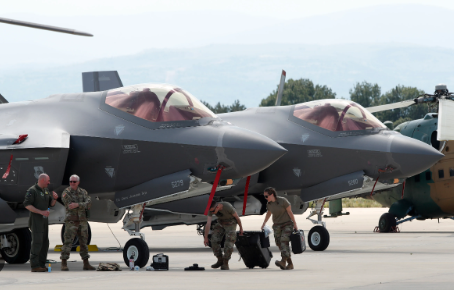
Canada is reevaluating its planned purchase of U.S. F-35 fighter jets over the escalating trade tensions between Washington and Ottawa in what has become a flash point in bilateral relations between the two allies.
Canada has committed to buying at least 16 F-35A Lightning II, a fifth-generation aircraft, produced by Lockheed Martin. Canadian Prime Minister Mark Carney is weighing whether to buy another 72. A mix of domestic political pressure, rising costs and an increasingly contentious relationship with President Trump has prompted Carney’s government to consider looking elsewhere for military hardware.
Vincent Rigby, who previously served as national security and intelligence adviser to Justin Trudeau’s government, said the escalating rhetoric from Washington has pushed a lot of policymakers in Canada to rethink the defense relationship between the two neighbors.
“We defend the North American continent very closely with the United States. I think our national interest in that respect will always converge, we hope. At the same time, they’re saying stuff, doing stuff that really puts us in a difficult position,” Rigby said in an interview with The Hill.
“And so one of the things that we’ve been thinking about more and more is we should be buying less from the United States and diversifying our defense relationships, buying more equipment, procuring more stuff from Europe, from the Indo-Pacific region, from countries like South Korea. And this is a big break. This is a real, real departure.”
Canada in 2022 agreed to purchase 88 F-35 fighter planes, which can fly nearly undetected into adversary territory, function as battle management systems and carry long-range antiship missiles, but the deal has encountered hiccups on the way, with delivery time sliding backward and costs ballooning by more than $27 billion.
With trade tensions flaring between Ottawa and Washington since Trump’s return to office, Carney initiated a review of the deal in March last year, which remains ongoing.
The rift between the U.S. and Canada over the F-35s seemingly widened last month when the U.S. ambassador to Canada, Pete Hoekstra, said during an interview with CBC that if Ottawa does not buy the Lockheed Martin-made F-35s, North American Aerospace Defense Command (NORAD), a defense partnership operated jointly by the two countries, “would have to be altered” — with Washington flying warplanes into Canada’s airspace more frequently.
The State Department later clarified that Hoekstra was not threatening to change the terms of the agreement, which stretches back to 1957, but was commenting on how Canada’s purchase of F-35s fits into plans to modernize the defense partnership.
“If Canada decided to significantly reduce its investment in the F-35, that would create a significant gap in the defense structure of North America,” the State Department said in a statement to The New York Times. “Filling that gap is not news, it is common sense.”
The Hill has reached out to the State Department for comment.
Still, Hoekstra’s comments sparked confusion and fears over the stability of the defense partnership between Canada and the U.S.
One former Canadian official told the CBC that Hoekstra’s remarks were “clearly a political pressure tactic to force the Canadian government’s hand.”
Andrea Charron, the director of the Centre for Defence and Security Studies at the University of Manitoba, said it wouldn’t work.
“If his end goal was to urge Canada, to hurry up, make a decision about the F-35s and go for the full compliment, which I think is actually best for Canada, this achieves the exact opposite effect,” she told The Hill.
Carney’s government is considering ordering the Swedish-built Saab JAS 39 Gripen, a fourth-generation aircraft, to upgrade its air fleet and replace the Boeing F/A-18 Hornet fighters, although former Canadian military officers have urged the government to stick with the Lockheed Martin jets.
Others in Canada have argued that sticking with F-35s would leave Canada overly dependent on the U.S. and its unpredictable foreign policies. The Pentagon keeps a level of oversight over sustaining and upgrading the jets even after a sale.
“We just don’t know where the U.S. is going to be in three, four or five years.” said Rigby, the former Trudeau adviser, who is currently a nonresident senior adviser with the Americas Program at the Center for Strategic and International Studies.
“We need to walk a tightrope. We push back on the U.S. where we have to, we diversify where we have to, but we’re still going to buy equipment from them, and we still have common interests, in particular in the defense of North America,” he added.
A majority of surveyed Canadians, 72 percent, back incorporating the Gripen into Canada’s air force, either by maintaining a mixed fleet of F-35s and the Gripen or by switching to the Swedish-made aircraft for future acquisitions, according to an EKOS Politics poll from December. Only 13 percent of survey respondents said that Canada should stick with F-35s as its main fighter plane.
Last month in Davos, Switzerland, Carney touted Canada’s plan to double its defense spending by the end of this decade and to build up domestic industries, with Carney emphasizing that Ottawa is “rapidly diversifying abroad.”
Charron, who is an expert on NORAD, argued that Canada should follow through on the deal given the F-35s are more advanced aircraft and because Canadian pilots should be equipped with the most advanced jets to stay equal to or ahead of their adversaries.
“As capable as the Gripens are, we cannot deny the fact that they are a different generation fighter,” she said.
She also said the logistics of managing three different fighter jets would be a major challenge to the Canadian armed forces.
“Because of the technological advancements of these platforms, they require sort of bespoke mechanical expertise and supply chain. There is a limit to how many platforms that Canada can support at any one time,” she said.
“I think [what] we need to do is make a decision on what is the platform that can do the most amount of things that we need it to do.”
