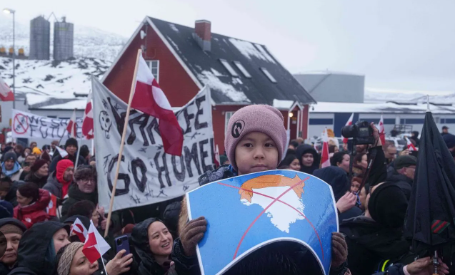
Few Greenlanders believe it would be advantageous for the territory to become part of the U.S., according to a new poll released after President Trump’s threats to acquire the island roiled the U.S.’s relationship with its European allies.
The poll, published by the Copenhagen Post in Denmark, found that 76 percent of Greenlanders do not think they would benefit from joining the U.S., compared to 8 percent who supported the idea and 16 percent who were unsure.
Sune Steffen Hansen, who conducted the survey, told the Danish newspaper that the findings underscore that people living in Greenland are “quite satisfied” with the current situation.
The poll also found that a majority of Greenlanders hold a negative view of America’s welfare system, including health care, elder care and education. Only 10 percent of adults said they had a “mainly” or “very” positive view of the U.S. system, according to the Wall Street Journal.
Greenland, a self-governing Danish territory, operates under a welfare system similar to that of other Nordic countries, providing universal health care, social security, and other benefits to all residents. The system is largely funded by block grants from the Danish government, which has reportedly pledged an additional 1.6 billion Danish crowns ($253 million) for health care and infrastructure investments through 2029.
Danish leaders, including Foreign Minister Lars Løkke Rasmussen, have expressed skepticism that the U.S. would fund a similar system in Greenland if they were to take control.
“I think there’s no way that the U.S. will pay for a Scandinavian welfare system in Greenland, honestly speaking. You haven’t introduced a Scandinavian welfare system in your own country,” Rasmussen said in a Jan. 15 interview on Fox News, weighing in on reports that the Trump administration was considering direct payments to Greenlanders to encourage them to split from Denmark.
The poll was conducted from mid-to-late January, when Trump and other senior U.S. officials were ratcheting up their rhetoric around Greenland, arguing that it must come under American ownership to protect national security interests and thwart Russian and Chinese aggression in the region.
Trump refused for weeks to take the prospect of military force to seize Greenland off the table, but later backtracked in a speech at the World Economic Forum in Davos, Switzerland.
He also announced that he had reached “the framework of a future deal” with NATO with regards to security and mineral rights and walked back proposed tariffs on Denmark and other European allies.
The reversal likely came as a welcome sign to the 54 percent of Greenlanders who said that they were worried or very worried that the U.S. would deploy military forces inside the country.
Officials from the U.S., Denmark and Greenland appeared optimistic following the first meeting of a high-level working group last Thursday.
Still, foreign leaders acknowledged ongoing pressure from Trump related to Arctic security, laying out several “red lines” around maintaining sovereignty.
“We are under pressure, serious pressure … as Greenland leaders, we have to deal with people who are afraid and scared,” Greenlandic Prime Minister Jens-Frederik Nielsen told a university audience Thursday in Paris, according to Politico Europe.
“We have some red lines we cannot cross, but from a Greenlandic perspective, we will try to sort out some sort of agreement,” he continued.
The Copenhagen Post poll was conducted from Jan. 16 to Jan. 28 among 610 adults in Greenland, via phone and online. The margin of error is approximately 4.0 percentage points.
