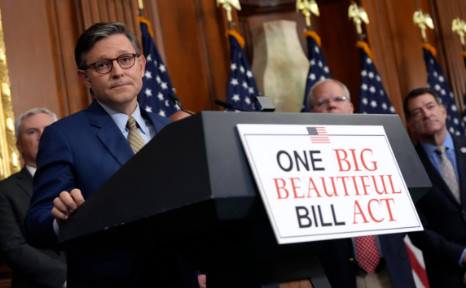
Republicans’ One Big Beautiful Bill Act will shrink the size of the U.S. population by hundreds of thousands of people, mostly due to new laws supporting Trump’s immigration crackdown.
The Congressional Budget Office (CBO) found Wednesday that by 2035, there will be 320,000 fewer people in the U.S. subject to Social Security and 280,000 fewer people in the noninstitutionalized population, the group of U.S. people who aren’t in prison, the military or in long-term medical care.
The numbers are relative to a January estimate and are “highly uncertain,” depending on factors like judicial rulings and detention capacity, the CBO cautioned.
The bill allotted more than $70 billion over four years to U.S. Customs and Border Protection (CBP) to boost border security operations. It also gives $47 billion for physical barrier infrastructure, $5 billion for new CBP facilities, and $4 billion for increased hiring.
Wednesday’s CBO estimate is broadly consistent with some other recent estimates, which also show a huge expected drop in immigration for this year. The American Enterprise Institute, a conservative think tank, estimated a net outflow of 205,000 people from the U.S. for 2025.
UP NEXT:
Republicans’ new law is also expected to have a major effect on the population growth rate, which is expected to rise by 0.2 percent per year — less than one-fifth the average annual growth rate seen from 1975 to 2024, when it was 0.9 percent per year.
The report shows that immigration to the U.S. has been soaring since the pandemic, with net immigration being several multiples larger than the total number of people who are born and die each year. Net immigration is expected to even out with net births around 2055 as population growth taper down toward zero.
The population drop is likely already having significant economic effects. Job creation has fallen off a cliff in recent months, with the economy adding just 22,000 jobs in August. Over the last three months, a slim 29,000 jobs have been added per month.
But despite the reduced pace of job creation, the labor market is not wildly out of balance. The unemployment rate ticked up to 4.3 percent in August from 4.2 percent in July, and the ratio of unemployed people to available jobs is close to 1-to-1, though it favors employers.
Federal Reserve Chair Jerome Powell described employment conditions as “curious” in August, with both demand for workers and the available supply coming down together in recent months. Other recent data has shown that employees are holding onto their jobs during this resetting period. Despite the overall balance, Powell has stressed that downside risks are mounting.
“This unusual situation suggests that downside risks to employment are rising,” he said last month. “And if those risks materialize, they can do so quickly in the form of sharply higher layoffs and rising unemployment.”
The CBO expects the population dip coming from the One Big Beautiful Bill over the next few years to be mostly a result of forcible removals of migrants but also due to voluntary emigration as well as detention.
The removal of 290,000 immigrants and the emigration of 30,000 people is expected to occur between 2026 and 2030. About 50,000 people will be held in jails, prisons and other facilities between 2026 and 2029 as a result of the law.
