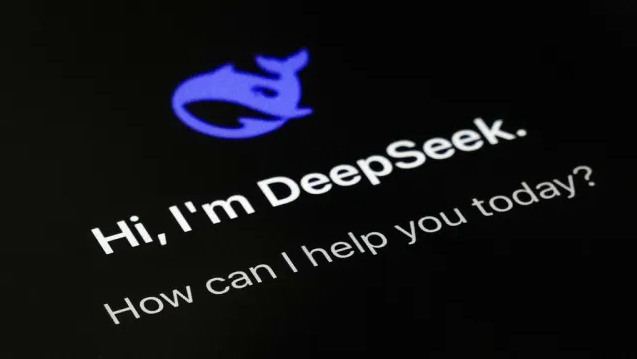
(The smartphone apps DeepSeek page is seen on a smartphone screen in Beijing, Jan. 28, 2025.)
Much of the AI discussion in the U.S. has centered on the need to win the technology race with China. While the U.S. is focused on achieving the most advanced frontier AI technologies, we are losing the global market to China.
Most of the world is not looking for the most cutting-edge frontier model. They are looking for something they can afford and that works. While the U.S. is investing in the most advanced technologies, China is actively pushing its cheaper models around the developing world. Losing this race will have long-term negative implications for the United States.
The competition in these countries will help determine whether U.S. or Chinese technology runs their infrastructure, supports their hospitals and classrooms, and delivers government services.
As Chinese products and services are brought in to run infrastructure, classrooms, airports, and government services across Africa, Asia and Latin America, China is building long-term relationships that will be difficult for the U.S. to penetrate.
Purchasing Chinese technology also brings risks. Chinese technology may be less secure than American technology, creating potential national security threats. China also frequently sells technology that enables countries to surveil their populations.
Next
Stay
By focusing on open-weight models, China is making its technology easier for others to adopt. Unlike many American models, which are only available through services controlled by their companies, Chinese models such as DeepSeek and Alibaba’s models are available for others to download and adapt.
Huawei is already expanding its significant footprint throughout the Global South. In April, Huawei announced AI services in nine additional countries, including Brazil, Indonesia, and South Africa, offering access to DeepSeek and other Chinese models through its cloud network. In Egypt, Huawei offered eligible startups up to $150,000 in cloud credits to help pay for computing services, along with training and an Arabic-language model. These offers lower the cost of getting started and encourage local companies to build around Chinese technology.
Microsoft estimated that DeepSeek usage in Africa was two to four times higher than in other regions during the second half of 2025. Its report also pointed to the free access and partnerships that DeepSeek offers to distribute its technology.
Chinese cloud providers are also expanding globally, with a particular focus on emerging markets. In Latin America, a 2025 study found that Chinese data center providers accounted for 25 percent of the market in Brazil, 40 percent in Chile, and 100 percent in Argentina, Mexico and Peru. The same study found that Chinese companies owned 57 percent of the data center market in Indonesia and 100 percent in Thailand, the Philippines and Malaysia.
As Chinese suppliers become the main providers of AI across developing economies, Beijing will be able to wield more influence in those countries. Once a government builds public services around a supplier’s systems, changing providers can become costly and disruptive. If essential services rely on Chinese suppliers for computing and technical support, a country may find it harder to challenge Beijing on other issues. Commercial choices made today could influence political choices tomorrow.
There are risks to information as well. U.S. government testing found that the DeepSeek models it examined repeated misleading Chinese Communist Party narratives more often than American comparison models. As people increasingly turn to AI to understand history and current events, those answers could give Beijing’s preferred version of the world a wider audience.
Finally, American businesses will lose future sales of software, computing equipment, and services, hampering their long-term viability and narrowing opportunities for the workers who build and support those products.
The expansion of China’s scientific and technological cooperation with the Global South has long been a priority for the Chinese government through its Digital Silk Road strategy, together with extensive financing to support and subsidize Chinese companies.
The loss of the U.S. Agency for International Development and the lack of a coordinated U.S. government approach to the Global South are hampering the development of a coherent strategy. The U.S. should make affordable access to AI and technology a central goal of its work with developing countries.
The U.S. has begun responding by promoting packages of American AI technology and making export financing more readily available. But these steps are not enough to compete with China in countries with limited budgets.
The U.S. should significantly increase the funding available to countries interested in purchasing U.S. AI and technology. It should also invest in training the people who will be the local users, partner with countries to train developers, support tools in local languages, and work with partner governments to identify problems they need to solve.
China is ahead in the technology race in the Global South, and the U.S. must move quickly to ensure that it does not lose the global AI race. Losing that race would have serious consequences for U.S. influence, national security, and our ability to shape how AI is developed and used around the world.
