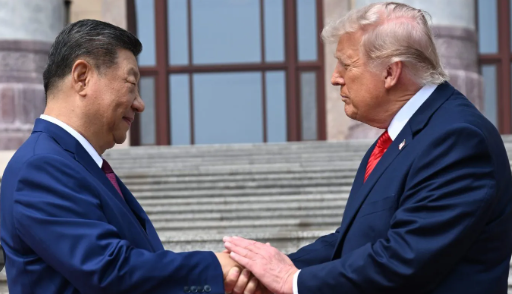
Views of the United States and President Trump are worsening around the globe, according to a survey published by the Pew Research Center on Wednesday. At the same time, China and its leader, Xi Jinping, are gaining more favorability, marking a reversal in worldwide opinions.
The Pew survey highlights the increasing challenge for the U.S. to exercise influence in a world where China is gaining increased favorability in Asia, Europe and the Western Hemisphere, while attitudes toward the U.S. are plummeting.
The Trump administration and bipartisan members of Congress warn that Xi’s ambition to elevate China to a dominant economic and military force on the world stage threatens U.S. economic and security interests.
“Views of China have improved in recent years while opinions of the U.S. have worsened, to the point where China is now seen more positively than the U.S. in most of 36 countries surveyed,” the report states.
“During the first two years of Trump’s second term, ratings of the U.S. president worsened significantly. While many people still lack confidence in Xi, positive views of him have become more widespread, and more overall now say they have confidence in Xi than in Trump.”
Pew surveyed more than 42,000 people across 36 countries, gathering opinions of Trump, Xi, their approaches to foreign policy, and how people view how the U.S. and China respect personal freedoms, among other survey questions. The results are divided between a report on how views of China and Xi are improving globally, and a report comparing the U.S. and China.
The survey was conducted between February 8 and May 13. Last month, Pew released other findings from that survey on specific global attitudes toward the U.S., which found global views of America and Trump were overwhelmingly negative.
Global attitudes toward the U.S. president began declining in President Biden’s final term in office and then accelerated as Trump took office, the recent survey publication notes. Only 21 percent of those surveyed have confidence in Trump to do the right thing regarding world affairs.
People generally lack confidence in Xi to do the right thing regarding world affairs, but people in many of the 36 countries view Xi more favorably.
“In European countries, for example, neither leader gets a majority-positive rating, but views of Xi tend to be more favorable than views of Trump,” the report states.
“In Germany, Greece, Italy, the Netherlands, Spain, Sweden and the United Kingdom, Xi leads Trump by double digits, though his highest favorability rating is just 37 percent, from the U.K.”
The gap in negative views between the U.S., and increasingly positive views of China, is most pronounced in several Asia-Pacific and Middle East countries, the report notes. America’s nearest neighbors, Canada and Mexico, also view China more positively than the U.S.
There are just six countries that hold a more positive view of the U.S. compared to China. This includes Israel (81 percent vs 19), India (45 percent vs 23), Japan (50 percent vs 11), the Philippines (56 percent vs 40) and South Korea (45 percent vs 28).
Over the course of three years, the U.S. and China favorability gap has reversed in many countries – including in European countries, now expressing a more favorable view of China compared to the U.S.
In Greece, the U.S. favorability is 37 percent compared to China’s 55 percent. In 2023, 56 percent of Greeks viewed the U.S. favorably compared to 40 percent who viewed China positively.
There’s a reversal in Italy, too, with 51 percent of the population having a positive view of China, compared to 36 percent three years earlier. The U.S. has a 31 percent favorability rating, compared to 60 percent three years earlier.
In Canada, the U.K., Australia, Sweden, Netherlands, Germany and France, those countries moved significantly toward having a positive view of China over the course of three years, while the U.S. view has dropped precipitously.
While global opinion still views the U.S. as respecting personal freedoms more than China, that number is shrinking. Thirty-nine percent of all those surveyed believe the U.S. respects personal freedoms, compared to 26 percent believing China respects personal freedoms.
Pew researchers also homed in on attitudes in Latin America toward the U.S. and China, given both Beijing’s investment in the region and the Trump administration’s renewed focus there, and warnings against Chinese influence. China has invested heavily in construction projects and trade relationships in Latin America that have, at times, impacted countries negatively.
Trump has threatened military force or severed ties against Latin American countries because of their ties with China, has effectively taken over Venezuela, is threatening Cuba and carrying out a military campaign in the Caribbean sea.
“The U.S. and China have both spent significant resources to exert influence over Latin America. China, for example, is South America’s top trading partner and has developed close economic and security ties with countries including Brazil and Peru,” Pew writes.
“President Donald Trump, meanwhile, declared at the Shield of Americas summit in March 2026 that the U.S. would ‘not allow hostile foreign influence to gain a foothold in this hemisphere,’ which prompted a response from China’s foreign minister.”
The Pew researchers say that views in Latin America of China are now slightly more positive than views of the U.S., due largely to worsening views of the U.S. People there generally lack confidence in both Trump and Xi to do the right thing regarding world affairs, they note.
“Views of the United States have grown more negative over the last year in five of six Latin American countries surveyed. Views of China, on the other hand, have mostly held steady,” the report notes.
“As a result, ratings of the two countries are now fairly close in several places throughout the region.”
But people in Latin America are much more likely to say the U.S. interferes in the affairs of other countries than they are to say the same of China. However, the researchers note people in these countries generally view both the U.S. and China in a fairly similar light as a reliable partner and contributing to global peace and stability.
