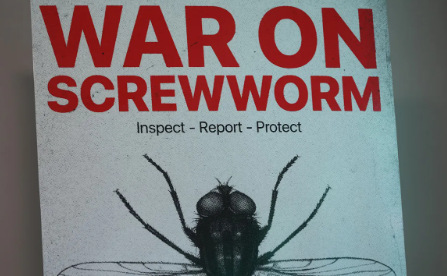
As cases of New World screwworm spread and threaten the beef and cattle industry, the Trump administration is rolling out a familiar playbook: Blame former President Biden.
The parasitic fly had been eliminated in the U.S. since the 1960s, but now it’s back, and according to Agriculture Secretary Brooke Rollins, the new resurgence is entirely due to the lax immigration policies of former President Biden’s administration.
“The threat didn’t appear overnight; it was the direct result of the Biden-Harris Admin’s WEAK foreign policy agenda and FAILED immigration policies,” Rollins wrote in a social media post last week.
In a CNBC “Squawk Box” interview Monday, Rollins continued to point fingers at Biden.
“Under the last administration with the massive movement under the open borders policy, the cartels, etc., border security, that’s when [screwworm] began to make its way back up toward America, hitting Mexico in early 2023, moving its way up through Mexico in 2024,” Rollins said.
The screwworm is a fly larva that eats living flesh instead of dead material. It has a track record of decimating livestock.
There are currently five confirmed cases: three calves and a goat in Texas and a dog from Lea County, N.M.
The government had been able to keep screwworm contained at the southern end of Panama for decades, in large part due to a program that breeds sterile male flies and drops them from planes to mate with wild females.
The U.S. had created a barrier by constantly releasing sterile flies in the area south of Central America since the early 2000s. That effort was aided by the difficult terrain of the Darién Gap, a mountainous rainforest that separates Panama from Colombia.
But for the past few years, the insect has been making its way north from South America.
In 2022, the flies overcame the insect barrier and the Darién Gap. Panama began to report dozens of cases, and by 2024, flies were found in Mexico.
At that point, federal and state officials and cattle ranchers knew it was inevitable the screwworm would make its way back into the U.S.
After Mexican officials confirmed a case of screwworm in November 2024, Biden’s Department of Agriculture (USDA) closed southern ports of entry to live cattle imports to prevent the spread of screwworm into the U.S.
But amid protests from the cattle industry, President Trump reversed that decision in February 2025.
The ports were closed again in May.
“We don’t really know why the boundary failed, but it was probably a combination of factors. It’s evidence that there was just an increasing pressure on the border with a large number of cases in Colombia” said Maxwell Scott, an entomologist at North Carolina State University.
Illegal cattle imports and interruptions in the sterile fly production all likely contributed, experts said.
“It wasn’t apparent at the time, but it would appear that the strain [of sterile fly] that was being used was losing effectiveness,” Scott said.
Once the barrier was breached, the spread has been rapid, with insects traveling hundreds of miles in weeks — a sign that people are moving infested animals.
“We would see a jump from one country almost to another country, and then even through Mexico, those jumps were 50 to 100 miles apart. Flies don’t travel that far, and neither do the wildlife on their own, especially if they’re being eaten by maggots,” said Sonja Swiger, an entomologist at Texas A&M University. “So, those are because animals were being put on trucks and moved.”
Sen. Roger Marshall (R-Kan.) blamed immigrants who are in the U.S. without legal permission.
“This is another thing we can thank Joe Biden for — that when millions of people came out of Central America, they brought this screwworm with them. It was on their pets, maybe on their flesh as well,” Marshall said on Newsmax.
Meanwhile, Democrats have been quick to blame the Trump administration.
The Department of Government Efficiency (DOGE) took a buzzsaw to the federal workforce, including employees in the USDA’s Animal and Plant Health Inspection Service.
The Trump administration also cut funding at USDA for programs that were specifically targeted to monitoring and responding to New World screwworm.
“Trump’s reckless and harmful cuts and his administration’s incompetence have left the U.S.’s food supply vulnerable to outbreaks and risk escalating already high prices for beef,” DNC Rapid Response Director Kendall Witmer said in a statement.
“Trump GUTTED funding for screwworm detection and fired 25 percent of workers whose job it was to monitor the disease,” Rep. Shri Thanedar (D-Mich.) wrote on X.
According to Rollins, staffing reductions haven’t hurt the response.
“There has been zero impact to this mission area, specifically to the screwworm, based on that reduction in force,” Rollins said during a briefing Monday.
She said the country has been quietly preparing for the past year and is ready with a warp-speed type response.
The administration named a senior adviser for New World Screwworm Preparedness, cattleman John Bellinger, on Monday.
“Every model showed that the New World screwworm would be here in Texas by early last summer, so we bought ourselves an additional year to prepare for this moment,” Rollins said.
Experts say what happens next matters more than how we got into the situation in the first place.
“Pushing it back all the way to the Panama-Colombia border took many years,” Scott said. Getting it back to that level “is going to take a lot more flies or new technology.”
Sterile flies are still the best way to eradicate the problem, and there are not enough being produced. At the time of their spread from Central America into Mexico, there was only one sterile fly production facility, located in Panama.
Other facilities that used to produce sterile flies have closed over many decades, a victim of their own success.
“We’ve never had a resurgence or reemergence … since we achieved eradication to Panama,” said Swiger. “People forgot what a screwworm can do, and that’s the main thing that really led to this.”
The Trump administration opened a new fly dispersal facility in February and in April broke ground on a new production facility. The U.S. broke ground on a new sterile fly production facility in April, although it is not expected to be operational until next year.
