Vice President JD Vance reassured Americans on Tuesday that President Donald Trump’s war with Iran will not become a “forever war,” using a White House briefing to defend his boss’s policies as speculation about his potential successor builds.
Standing in for press secretary Karoline Leavitt, who is on maternity leave, Vance fielded questions from journalists for nearly an hour in a mostly measured manner, a contrast to Trump’s more confrontational style.
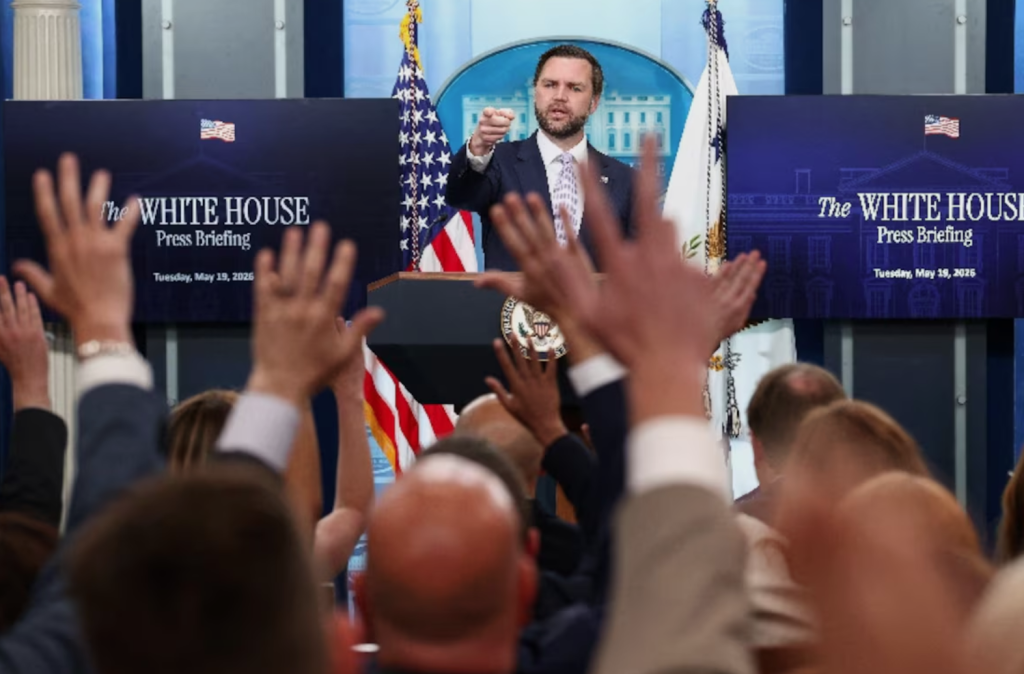
He declined to rule out using taxpayer money to compensate people convicted of assaulting police officers during the January 6, 2021, attack on the U.S. Capitol, dismissed European concerns over Washington scrapping troop deployment to Poland as overblown and called a reporter’s suggestion that Trump’s recent stock purchases raised corruption concerns “absurd.”
The White House briefing room has emerged this month as an informal audition stage in the race to succeed President Donald Trump in 2028. Vance’s appearance at the podium came about two weeks after Secretary of State Marco Rubio, his possible future rival, drew wide attention for his debut briefing.
“Marco’s right, this really is chaos,” Vance quipped as reporters who packed the room shouted for his attention.
When a reporter referred to Vance as “a potential future candidate,” he rushed to correct her.
“I’m not a potential future candidate,” he said. “I’m a vice president, and I really like my job, and I’m going to try to do as good of a job as I can.”
IRAN WAR PRESENTS POLITICAL TEST
Vance, 41, a former Marine who has long argued against U.S. entanglements in foreign wars, on Tuesday said any escalation with Tehran in the absence of a diplomatic solution would serve long-term U.S. security interests.
“This is not a forever war,” he said. “We’re going to take care of business and come home.”
The Iran conflict is likely to loom over the political futures of both Rubio and Vance. Since it began on February 28, it has shut down a large chunk of the global oil trade, sending U.S. gas prices about 50% higher and raising alarm among Republicans defending congressional majorities in the November midterm elections.
