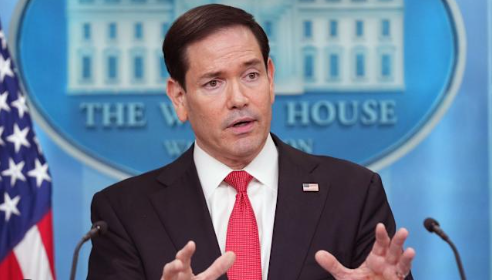
Secretary of State Marco Rubio on Tuesday argued the War Powers Act is unconstitutional, adding that the Trump administration is only complying with “elements” of it to maintain good relations with Congress.
“The War Powers Act is unconstitutional, 100 percent,” Rubio told reporters during a White House briefing, claiming that his position has been shared by “every single president” that has occupied the Oval Office since the law passed in 1973.
Also known as the War Powers Resolution, the federal law requires the sitting president to seek congressional authorization for foreign conflicts. Meant to function as a check on the commander in chief’s ability to begin or escalate hostilities, the law mandates the president must notify Congress within 48 hours of deploying troops in response to an “imminent threat,” and requires American forces be withdrawn from any conflict within 60 to 90 days unless Congress declares war or authorizes the action.
President Trump ordered a start to the U.S.-Israeli war in Iran on Feb. 28 but did not formally notify Congress until March 2. As the conflict passed its 60-day mark on Friday, Trump was asked whether he would seek approval from lawmakers. He replied that “it’s never been sought before” and that the law was “totally unconstitutional.”
The administration last week argued in a letter to Congress that the clock on the War Powers Act stopped when Trump declared a 14-day ceasefire with Iran on April 7, which he has since extended indefinitely.
On Tuesday, Rubio said gestures of compliance with the law did not mean officials “acknowledge the law as constitutional.”
“Now we comply with it in terms of, like, notification because we want to preserve good relations with Congress, right? And we do that,” Rubio said.
He also stressed that it’s not only Trump’s position that the law is unconstitutional, but that it “has been the position of every single presidential administration since the day that law passed, as an infringement on the president’s constitutional powers.”
Rubio added that the administration wants Congress to be involved and informed, even as lawmakers on both sides of the aisle have frequently complained that the White House and Pentagon have been tight-lipped on everything from operations against Iran, to the cost of the conflict, to how badly U.S. bases and assets in the Middle East have been damaged.
Senate Democrats have unsuccessfully tried six times to pass a war powers resolution to stop American military operations against Iran without approval from Congress, with the most recent vote on Thursday failing 47-50. Republican Sens. Susan Collins (Maine) and Rand Paul (Ky.) voted with Democrats.
“I have gone on Capitol Hill four times this year for all senators and all House members and [the] Intel Committee and Gang of Eight. We want them to be involved in this,” Rubio said, referring to the leaders of each of the two parties from both the House and Senate, and the chairs and ranking members of both chambers’ intelligence committees.
Washington and Tehran are currently locked in a stalemate over the Strait of Hormuz, a critical maritime transit route when Iran has attacked ships that attempt to pass through without coordination.
Defense Secretary Pete Hegseth said earlier Tuesday that the tit-for-tat attacks between U.S. warships and Iranian speedboats in the strait this week did not violate the ceasefire.
On Monday, the U.S., which has imposed its own blockade on Iranian oil tankers and commercial ships, began Project Freedom, an effort to guide commercial vessels through the strait.
Rubio said the future of Iran’s nuclear program remains a key dispute between the two sides, but the administration hopes it could be resolved through negotiations.
