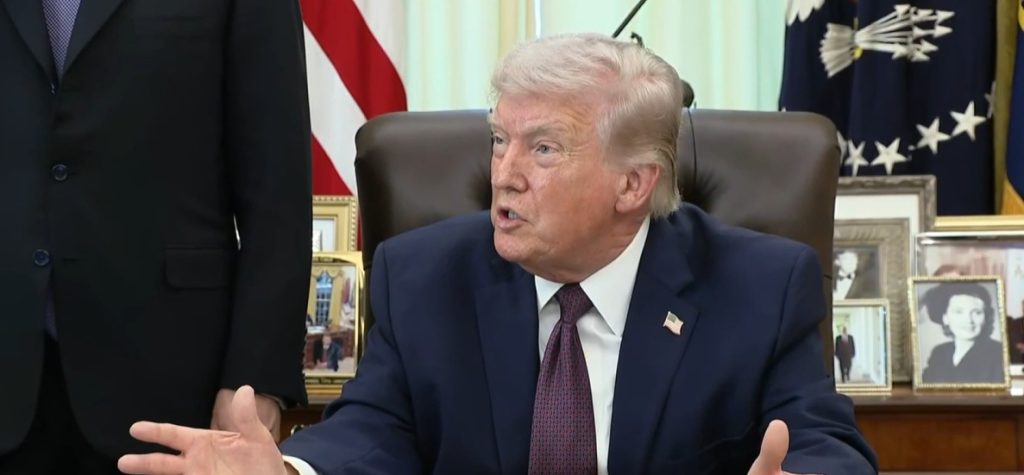
President Donald Trump is again trying to exert control over American elections, signing an executive order Tuesday that aims to create federal lists of citizens and ask the U.S. Postal Service to transmit mail ballots to only those people.
The executive order, his second related to elections since he retook office last year, is sure to be quickly challenged in court. The U.S. Constitution gives states the power to set voting rules and administer their own elections, though Congress has the ability to set some regulations, too.
“That’s a big deal,” Trump said as he signed the order in the Oval Office, adding that he didn’t believe the courts could overturn it. “I think this will help a lot with elections. We’d like to have voter ID. We’d like to have proof of citizenship, and that’ll be another subject for another time. We’re working on that. You would think it’d be easy.”
The order asks the Department of Homeland Security to create “state citizenship lists” from federal citizenship and naturalization records, Social Security records and other federal databases.
Those lists would then be sent to the states to verify their voter rolls, and the USPS would be asked to transmit ballots only addressed to people on state citizenship lists. It’s unclear how the USPS, a chronically underfunded agency, would absorb the mandate to police election mail as required by the order.
Two key players in failed efforts to overturn the 2020 election, which Trump lost — Kurt Olsen and Heather Honey — were involved in discussions around the executive order, according to a person familiar with the preparations. Olsen is now director of election security and integrity at the White House, while Honey works in a senior role at the Department of Homeland Security.
Election experts said they expected the order would be deemed unconstitutional by the courts.
“This will be blocked by the federals courts before the ink is dry,” said David Becker, founder of the nonpartisan Center for Election Innovation & Research, which works to support election administrators.
“The Constitution clearly gives the power to regulate these issues related to mail ballots to the states,” Becker continued. “The president has been excluded by the framers from dictating election policy to the states.”
Trump has long had his sights set on altering the voting process in the U.S. as he has continued to falsely claim he won the 2020 election.
“I won three times. I won three times convincingly,” he said Tuesday after he signed the order.
Even as Trump has repeatedly attacked voting by mail as “cheating,” he has used the method to cast a ballot himself in the past, including in a special election for a state legislative seat in Florida earlier this month.
Trump also suggested this year that he supported nationalizing elections in at least some areas, which raised alarms among state election officials.
“The Republicans should say: ‘We want to take over. We should take over the voting in at least — many, 15 places,’” Trump said in an interview on a conservative podcast in February. “The Republicans ought to nationalize the voting.”
He signed an executive order in March of last year that sought to impose documentary proof-of-citizenship requirements to register to vote and cut funding to states that provide grace periods for mail ballots to arrive. The courts blocked many provisions of that order.
Trump has also put pressure on Congress to pass the SAVE America Act, which would impose new proof-of-citizenship and voter ID requirements.
The legislation passed the House, but it has stalled in the Senate, where it needs 60 votes to advance under current chamber rules.
