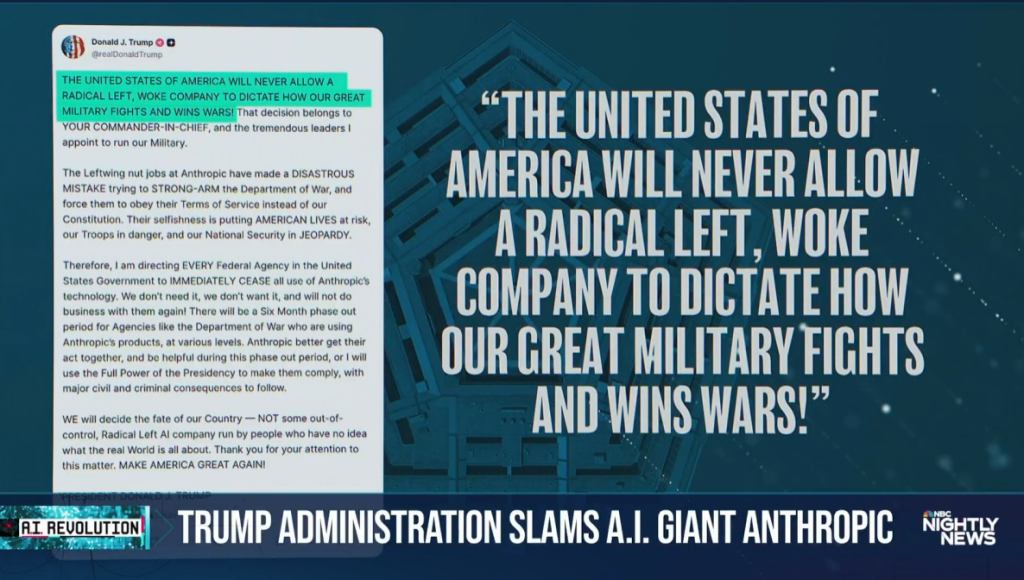
President Donald Trump said Friday that he was banning federal agencies from using the services of AI company Anthropic.
The declaration came after months of increasingly heated rhetoric between the Defense Department and Anthropic over the military’s use of the company’s systems.
“I am directing EVERY Federal Agency in the United States Government to IMMEDIATELY CEASE all use of Anthropic’s technology. We don’t need it, we don’t want it, and will not do business with them again!” Trump wrote in a post on Truth Social.
Shortly afterward, Defense Secretary Pete Hegseth announced on X that he would direct the Defense Department to label Anthropic a “Supply-Chain Risk to National Security.”
The move, usually reserved for foreign adversaries, would bar any military contractor or supplier from doing business with Anthropic. Both Hegseth and Trump announced agencies would have six months to phase out any existing federal business with Anthropic.
Hours after the Trump administration’s comments, OpenAI CEO Sam Altman posted on X Friday night that the company had struck a deal with the Department of Defense to deploy its models on the department’s classified networks.
Altman said the Department of Defense “displayed a deep respect for safety and a desire to partner to achieve the best possible outcome” in their interactions.
“AI safety and wide distribution of benefits are the core of our mission,” Altman wrote. “Two of our most important safety principles are prohibitions on domestic mass surveillance and human responsibility for the use of force, including for autonomous weapon systems. The DoW [Department of War] agrees with these principles, reflects them in law and policy, and we put them into our agreement.”
Altman also said OpenAI will create “safeguards to ensure our models behave as they should, which the DoW also wanted.”
It is unclear if or how the safety-focused measures in OpenAI’s agreement differ from those in the Anthropic negotiations.
Anthropic, AI industry push back
Following the directives from Trump and Hegseth, Anthropic posted a statement on its website saying the company had “not yet received direct communication” from either the Pentagon or Trump, but threatened to sue.
“We will challenge any supply chain risk designation in court,” the statement said.
“We believe this designation would both be legally unsound and set a dangerous precedent for any American company that negotiates with the government,” it said.
Anthropic, led by CEO Dario Amodei, has made clear in months of contract negotiations with the Pentagon that it would not allow its AI systems to be harnessed for domestic surveillance or direct use in lethal autonomous weapons.
The Pentagon has maintained that it must be allowed to employ its AI systems for “any lawful use,” which may cross some of Anthropic’s red lines.
“I believe deeply in the existential importance of using AI to defend the United States and other democracies,” Amodei wrote in a statement Thursday night, but “using these systems for mass domestic surveillance is incompatible with democratic values.” Amodei added that “today, frontier AI systems are simply not reliable enough to power fully autonomous weapons.”
Hegseth’s post prompted significant criticism from the AI industry.
An open letter to the Pentagon and Congress signed by some prominent tech and AI leaders circulated Friday night. Signatories included eleven OpenAI employees, including Boaz Barak and William Feng, and Alexander Persky-Sterm, the CEO of Waymark.
“We strongly believe the federal government should not retaliate against a private company for declining to accept changes to a contract,” it said.
“This situation sets a dangerous precedent. Punishing an American company for declining to accept changes to a contract sends a clear message to every technology company in America: accept whatever terms the government demands, or face retaliation. The United States is winning the AI competition because of its commitment to free enterprise and the rule of law; undermining that commitment to punish one company is short-sighted and antithetical to our national security interests,” it said.
Dean Ball, who previously served as Trump’s Senior Policy Advisor for Artificial Intelligence, posted on X that “This is simply attempted corporate murder.”
“I could not possibly recommend investing in American AI to any investor; I could not possibly recommend starting an AI company in the United States,” he wrote.
In a series of tweets late Thursday night, Undersecretary of Defense Emil Michael wrote on X that Amodei “is a liar and has a God-complex. He wants nothing more than to try to personally control the US Military and is ok putting our nation’s safety at risk.”
Lawmakers call for de-escalation
Earlier Thursday, Pentagon chief spokesperson Sean Parnell wrote on X that the Pentagon’s desire to use Anthropic’s model for all lawful purposes “is a simple, common-sense request that will prevent Anthropic from jeopardizing critical military operations.”
Anthropic currently has a contract worth up to $200 million with the Pentagon to “advance responsible AI in defense operations” and works with data analytics company Palantir to provide its AI services on classified defense and intelligence networks.
Throughout Friday, a growing chorus of lawmakers called on the parties to de-escalate their feud and come to an amicable solution, contrasting with the relative silence from Anthropic and the Pentagon in the hours before the deadline.
In a letter to Hegseth made public Friday afternoon, Sens. Ed Markey, D-Mass., and Chris Van Hollen, D-Md., said the Pentagon’s “threats to punish an American AI company for refusing to surrender basic safeguards on the use of its AI model represent a chilling abuse of government power.”
Rep. George Whitesides, D-Ca., told Hegseth in a letter released Friday morning that he was concerned that his “threats to compel changes to safety policies on an accelerated timeline could push the Department toward broader deployment without sufficient guardrails.”
Sen. Mark Warner, D-Va., the ranking member of the Senate Intelligence Committee, said in an emailed press release that “The president’s directive to halt the use of a leading American AI company across the federal government, combined with inflammatory rhetoric attacking that company, raises serious concerns about whether national security decisions are being driven by careful analysis or political considerations.”
AI models on classified networks
Unlike many major defense technologies, today’s leading AI systems have been developed primarily in the private sector, by companies like Anthropic, OpenAI and Google. The increasing capabilities of these systems have forced the Pentagon to bargain with Anthropic over its usage policies or opt for a less proven services. Until this week, Anthropic was the only leading AI company that had been cleared to offer services on classified networks.
In a memo sent to OpenAI employees Thursday evening and viewed by NBC News, Altman said that his company would largely follow Anthropic’s approach if it were in the same position with the Pentagon.
“We have long believed that AI should not be used for mass surveillance or autonomous lethal weapons, and that humans should remain in the loop for high-stakes automated decisions. These are our main red lines,” he wrote.
Altman added that “this is no longer just an issue between Anthropic and the DoW; this is an issue for the whole industry and it is important to clarify our stance.”
It’s unclear how other leading AI companies would respond. Google, Meta and xAI did not respond to a request for comment.
