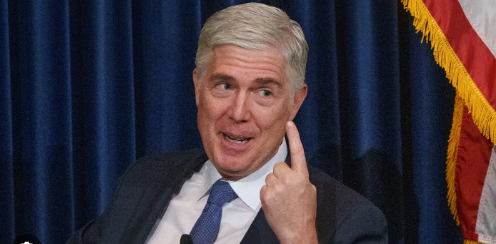
Supreme Court Justice Neil Gorsuch is having an ‘I told you so’ moment when it comes to President Trump’s tariffs.
At November’s blockbuster arguments, Gorsuch raised alarm about what he called a “one-way ratchet” of authority from Congress to the president if Trump wins a case that challenges his use of emergency powers to impose duties on a host of countries.
“It’s going to be veto-proof,” Gorsuch warned of Trump’s declared emergencies.
“What president’s ever going to give that power back? A pretty rare president. So how should that inform our view?”
Gorsuch’s concern is now in the limelight as the justices prepare to return to the bench to issue opinions on three separate days between now and next Wednesday.
Last week, Trump saw one of the first major pushbacks from Congress on the matter, when six House Republicans joined Democrats in voting 219-211 to repeal Trump’s Canada tariffs under the International Emergency Economic Powers Act (IEEPA). That measure now heads to the Senate, where four Republicans joined Democrats last year on a similar effort. The new vote only needs a simple majority.
But even if it gets to Trump’s desk, the revolt is largely symbolic. The bipartisan support for repealing the tariffs falls far short of the two-thirds majority needed in both the House and Senate to override an expected veto.
Gorsuch saw it coming — and he wasn’t the only Trump-nominated justice to read the tea leaves back at November’s arguments.
“Let’s say that we adopt your interpretation of the statute,” Justice Amy Coney Barrett told the government. “If Congress said, ‘Whoa, we don’t like that, that gives a president too much authority under IEEPA,’ it’s going to have a very hard time pulling the tariff power out of IEEPA, correct?”
Congress can amend IEEPA at any time to make clear whether the 1977 law does, or does not, authorize Trump’s tariffs. Speaker Mike Johnson (R-La.) has expressed no appetite for doing so, leaving the nine justices to parse the nearly half-century-old phrasing that has left global financial markets in suspense for months.
“I think the sentiment is that we allow a little bit more runway for this to be worked out between the executive branch and the judicial branch,” Johnson said last week.
No one outside the court knows if the tariffs’ opinion is being sent to the printers right now, or if there’s still time for tweaks. When it is released, watch to see if any of the justices take note of the recent developments on Capitol Hill.
The Trump administration hopes to convince the justices that Congress can, indeed, claw back power from the president. Solicitor General D. John Sauer would like everyone to remember that Congress clubbed together the votes to terminate the massive COVID-19 emergency just a few years ago.
“What the statute reflects is there’s going to be the ability for a sort of political consensus against a declared emergency. Nevertheless, that’s a political discipline,” Sauer said during the tariff arguments.
Speculation is still running rampant about exactly when the Supreme Court will release the highly anticipated decision. Some 105 days have now passed since oral arguments, longer than other recent expedited cases.
When asked about the wait during her book promo on “CBS Mornings” last week, Justice Ketanji Brown Jackson didn’t think much of it. There are “lots of nuanced legal issues” and “it takes a while to write,” she said.
“The court is going through its process of deliberation, and the American people expect for us to be thorough and clear in our determinations, and sometimes that takes time,” Jackson said.
The fact the junior liberal justice said anything at all was notable, as Supreme Court justices typically steer clear of talking about pending cases. Full stop.
We’ve got our ears perked up. As the justices return to the bench, the court has signaled it will hand down opinions Friday, Tuesday and next Wednesday.
Bettors on prediction markets think it could be coming. After the court scheduled the opinion days, the odds of the tariff decision landing this month jumped from 40 percent to more than 70 percent on Kalshi, a popular prediction market.
Sandwiched between two of the opinion day releases is the State of the Union, scheduled for Tuesday evening.
Chief Justice John Roberts and several of the other justices typically attend; here’s the list of who has shown up each year. It’s a rare face-to-face moment between the justices and the president, with every move scrutinized.
As Roberts and the others sat in last year for Trump’s address, they were also sitting on the president’s emergency appeal seeking to freeze foreign aid. The justices released the decision — against Trump — at 8:59 a.m. the next morning.
