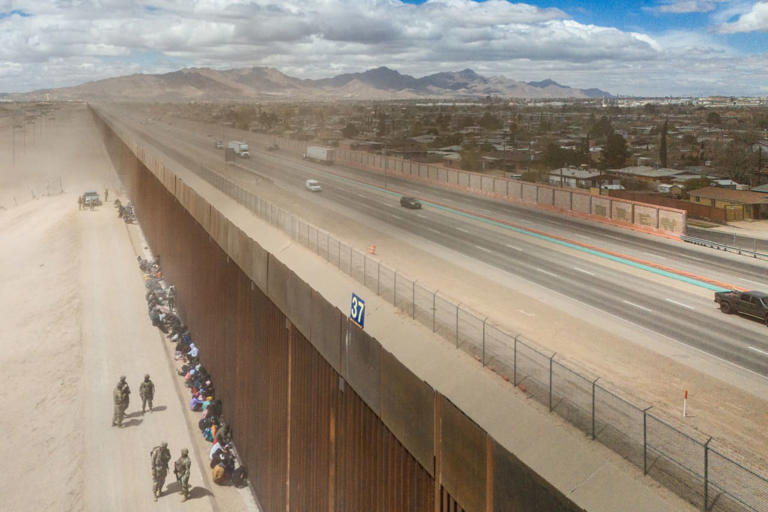
As President-elect Donald Trump prepares for border restrictions and deportations that formed the bedrock of his election victory, the state that has pioneered extreme immigration crackdowns is reaching out to lend a hand.
In recent weeks, Texas leaders offered some 1,400 acres of land on the border to the federal government for construction of deportation facilities and said the state was looking to offer more. Incoming Trump administration border czar Tom Homan joined Republican Texas Gov. Greg Abbott this past week in two Texas border cities, where he learned about the state’s border operation and visited its National Guard soldiers and state troopers.
The budding alliance comes as Abbott over the past three years has used his signature policy priority, Operation Lone Star, to challenge federal authority over immigration and push militarization of the border to new levels. The state has spent more than $11 billion to deploy thousands of National Guard and state troopers to border towns, erect barriers and create a system to jail migrants on low-level state misdemeanor charges.
The effort has had little effect on migration while facing charges of civil-rights abuses, The Wall Street Journal previously reported. But it has become a system that a Trump administration could potentially use, either hand-in-hand with the state or as an example to follow.
“This is a model we can take across the country,” Homan told troops last Tuesday.
Here are five ways the Trump administration could follow a Texas playbook:
State land for federal purposes
Last month, Texas Land Commissioner Dawn Buckingham announced that she had offered the Trump administration some 1,400 acres along the Rio Grande in rural Starr County. The state recently bought the land for $3.8 million and has suggested Trump build deportation facilities there. The land lies within the river’s flood plain and a person familiar with the sale said the previous owners had struggled to find other buyers because development there wouldn’t be feasible.
Buckingham said she wasn’t familiar with the flood-plain issues and that it was a strategic piece of property in an area with high number of illegal crossings by migrants. She said on Tuesday that her office had made a list of other state-owned properties to offer to the federal government.
“Our message to the Trump administration is ‘we’re here, we’re interested,’” she said. “Of course, we own property all over the state, so we’re ready to sit down with them and talk about what could be strategic.”
Representatives for Abbott and Trump declined to answer specific questions about how the state and administration could work together, but Trump spokeswoman Karoline Leavitt said: “President Trump will marshal every lever of power to secure the border, protect their communities, and launch the largest mass deportation operation of illegal immigrant criminals in history.”
Greater use of military force
Members of the National Guard have been deployed to the U.S.-Mexico border for decades, on federal orders under Republican and Democratic presidents and on state orders from governors around the country. They don’t have authority to enforce immigration law, so have typically supported Border Patrol by acting as extra eyes and ears.
Under Operation Lone Star, Texas has shifted such deployments from short-term to a permanent border fixture. The state has ordered soldiers to report for a year or longer and built a permanent base near the Rio Grande. Immigration experts expect Trump to similarly call up the Guard, perhaps with some sort of direct authority to detain people.
“They’ve made no secret of the fact that they want to push the envelope and use military forces to enforce immigration,” said Angela Kelley, a former Biden administration senior counselor for immigration. “That’s distinct from previous administrations that have used the Guard to do administrative work.”
Different border barriers
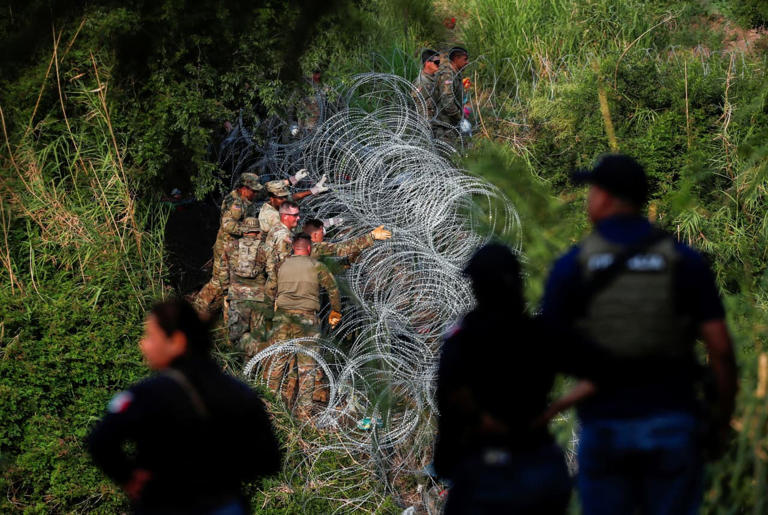
Texas has layered parts of the Rio Grande in razor wire, causing severe injuries to some migrants. Civil-liberties groups called the strategy unprecedented in its brutality, but Abbott and other immigration hard-liners have celebrated it.
The state has also tested a new system of floating barriers in the river. Environmental advocates have raised concerns that the string of buoys—which are no longer floating, but resting on a mud bank that has built up under them—could change the flow of the Rio Grande and possibly even the border itself down the center of the river. Abbott has called them a success, and the state recently added a second stretch of them.
Ron Vitiello, who served as acting director of U.S. Immigration and Customs Enforcement during Trump’s previous term, said he could see the incoming administration making use of border barriers that the Biden administration has fought states over, including the Texas buoys and a shipping-container wall in Arizona.
“There are probably some lessons learned over the Texas effort,” Vitiello said. “I hear a lot of good operational feedback from the buoys.”
Money for localities that cooperate
Trump has said he plans to declare a national emergency to carry out his deportation plans. Such a declaration would be similar to a state of disaster in place since 2021 in Texas, where localities have also been financially rewarded for participating in such efforts.
David Donatti, a senior staff attorney at the ACLU of Texas, noted the state grants to counties that declared border-related states of disaster. Under Operation Lone Star, Republican-led counties hundreds of miles from the border have been under states of disaster for years. That has led to unrelated arrests of citizens in places like Midland to be counted as arrests under the operation, and for those counties to receive funding for things such as court technology or improved morgues.
“These are grant programs, at the end of the day,” Donatti said, emphasizing that a monetary incentive can persuade localities of different ideologies to participate in immigration actions. “If you declare a disaster, we’ll give you a bunch of money to do different things.”
Dropping lawsuits
The Biden administration has sued Texas over several elements of Operation Lone Star, including the buoys and a state law allowing local authorities to order deportations. The state and federal government have tangled over Border Patrol’s ability to cut through state-placed razor wire as needed to perform arrests or rescues. While the Supreme Court previously gave the federal agency temporary emergency authority to remove the wire, the most recent order, on Wednesday from the Fifth Circuit Court of Appeals, blocks the federal government from interfering with it.
With Trump back in office, border-security experts from both parties said they expect those lawsuits to disappear. “When I’m president, instead of sending Texas a restraining order, I’ll send them reinforcements,” he said at a January rally.
Legal and immigration experts are watching closely to see if the Justice Department under Trump withdraws from leading a multi-plaintiff lawsuit over the state deportation law. The Texas law, and a similar one in Arizona, are direct challenges to federal immigration authority. Lawyers have said they could open the door to different states—including blue states—having different immigration policies and enforcement.
“Even the Trump administration may want to keep immigration enforcement on its terms,” said Donatti, who represents the ACLU, another plaintiff, on the case.
Write to Elizabeth Findell at elizabeth.findell@wsj.com
