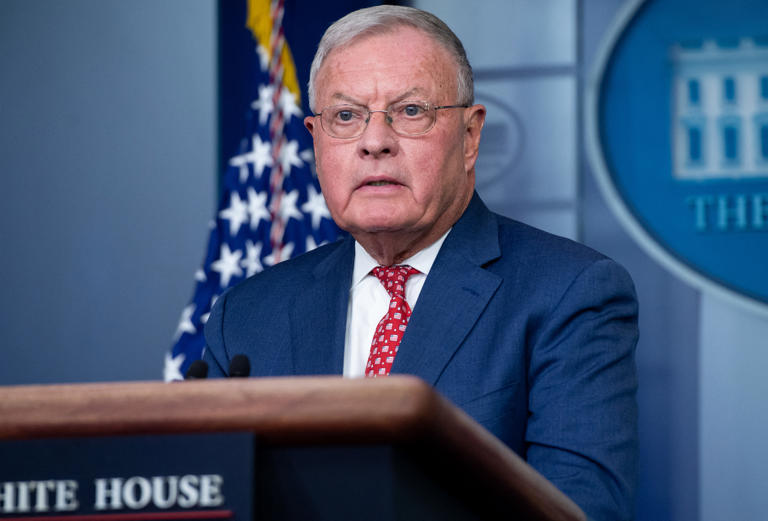
President-elect Donald Trump announced Wednesday that he would nominate retired Army Gen. Keith Kellogg as special envoy for Ukraine and Russia, bringing back a key adviser from his first term to help fulfill his top campaign promise of ending the war between the two countries.
“Together, we will secure PEACE THROUGH STRENGTH, and Make America, and the World, SAFE AGAIN!” Trump said in a social media post announcing Kellogg’s selection.
Kellogg, a retired lieutenant general, was chief of staff for the National Security Council during Trump’s first term. He also served as national security adviser to Vice President Mike Pence and briefly served as acting national security adviser to Trump.
Trump, in his Wednesday post, said Kellogg “was with me right from the beginning!” Kellogg will also carry the title of assistant to the president.
Kellogg accepted the appointment in a social media post, saying he looked “forward to working tirelessly to secure peace through strength while upholding America’s interests.”
Trump ran for president promising to quickly settle the conflict that broke out after Russia invaded Ukraine in February 2022. Trump regularly claimed he could end the war within his first 24 hours of returning to office.
But Trump largely declined to provide details on his strategy for winding down the war, and his campaign rhetoric raised concerns that he would be too deferential to Russia in any peace negotiations.
On the campaign trail, he suggested Ukraine could have averted the conflict by making unspecified concessions to Russia before its invasion.
Kellogg has been serving as co-chair of the Center for American Security at the America First Policy Institute, a conservative think tank aligned with Trump. In that role, Kellogg co-wrote an April report on the war that advocated a “formal U.S. policy to seek a cease-fire and negotiated settlement of the Ukraine conflict.”
“The United States would continue to arm Ukraine and strengthen its defenses to ensure Russia will make no further advances and will not attack again after a cease-fire or peace agreement,” the report said. “Future American military aid, however, will require Ukraine to participate in peace talks with Russia.”
Kellogg has also proposed delivery of U.S. weapons as a cudgel to bring Moscow to the table. If Putin were to refuse the opportunity to negotiate, he told Reuters in a June interview outlining potential diplomatic pressure on Russia, then the United States could give Kyiv “everything they need to kill you in the field.”
In 2022, Kellogg joined a coalition of conservative groups in signing a letter to lawmakers to delay consideration of a major new aid package to Ukraine. In the letter, obtained by The Washington Post, Kellogg and others warned that another Ukraine aid bill would “add to our already substantial national debt and budget deficit.”
Ultimately, Congress would opt to continue providing assistance to Ukraine over the objections of the groups.
The war in Ukraine is personal for Kellogg’s family. His daughter, Meaghan Mobbs, is president of the R.T. Weatherman Foundation, a group that has provided aid to civilians and repatriation of the remains of American volunteer fighters killed in battle.
Kellogg’s selection comes at a precarious time for Ukraine, whose soldiers are exhausted trying to contain months of Moscow’s advances along the eastern front. Russian commanders have harnessed illicit Starlink terminals to improve their coordination, dispersing in small assault teams backed by drones and artillery to push back Ukrainian forces across the Donetsk region, soldiers have said.
Russia’s gains, which coincided with Kyiv’s gambit to occupy Russia’s Kursk region, have led to some of the most rapid territorial losses Ukraine has experienced since 2022, analysts have said.
The Biden administration, in its twilight, has taken drastic steps to reverse Ukraine’s fortunes ahead of any potential negotiations. This month, President Joe Biden authorized Ukraine to fire U.S.-provided ballistic missiles into Russia, in response to the mobilization of thousands of North Korean troops helping Russia in Kursk.
The policy is a reversal of the White House belief that using such missiles was an escalatory risk and underscores the importance for both sides of holding Kursk, which will be an important bargaining chip if and when negotiations commence.
Kellogg argued in a Fox News interview last week that Biden’s approval of the missiles has “actually given Trump more leverage.”
“I’m hoping there’s something to this,” Kellogg said. “I don’t know, but it does give … President Trump more ability to pivot from that.”
Biden also authorized the transfer of antipersonnel mines to Ukraine this month to help curb Russia’s use of small assault teams taking Ukrainian positions on foot. The U.S. military had mothballed its inventory of antipersonnel mines, and Biden in 2022 reinstated a policy to ban their use or transfer outside the Korean Peninsula. His decision roiled arms-control groups, which pointed to the indiscriminate nature of the weapons and their enduring potential for harm.
Biden’s cautious strategy toward parceling out weapons and his late surge of policy changes have drawn criticism in Kyiv and from Ukrainian troops. Weapons arriving after long deliberations in Washington have diminishing returns because conditions on the battlefield have changed, leading to preventable casualties and setbacks, according to soldiers and commanders on the ground.
Kellogg is likely to work closely with Trump’s pick for national security adviser in his incoming administration, Rep. Michael Waltz (R-Florida). Waltz praised Kellogg’s selection on Wednesday, saying in an X post that Kellogg is “committed to bringing the war in Ukraine to a peaceful resolution.”
John Hudson contributed to this report.
