Taiwan’s incoming president, Lai Ching-te, will have the world’s attention when he delivers his inaugural address on Monday.
All ears will be on Lai’s language and framing of his administration as officials in Beijing, Washington, Tokyo and elsewhere scrutinize every word on cross-strait relations, particularly those that could suggest a departure from an already precarious status quo.
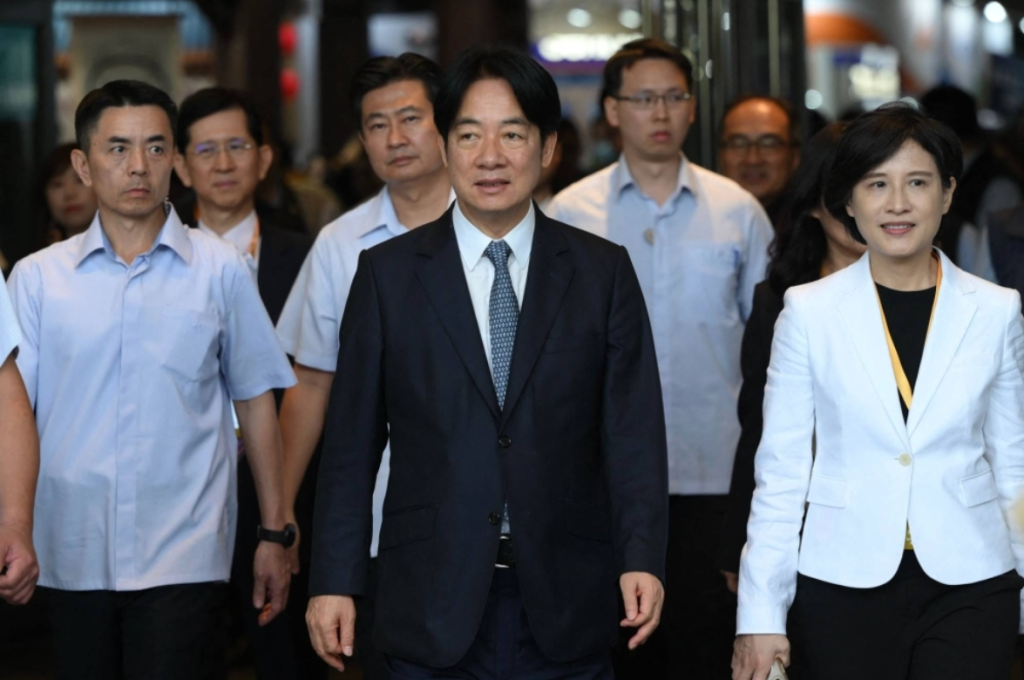
Special focus will be on how the 64-year-old, who once described himself as a “pragmatic worker for Taiwanese independence,” refers to the democratic island, how he talks about its autonomy and on which level he will try to navigate relations with Beijing amid a heightened risk of conflict.
Currently vice president, Lai will be taking the reins from President Tsai Ing-wen after winning a hotly contested election in January that was largely framed as a choice between change and continuity.
His victory — and that of running mate Hsiao Bi-khim — made the independence-minded Democratic Progressive Party (DPP) the first in the self-ruled island’s history to win three straight presidential terms, a vote of confidence for a party that has long emphasized that Taiwan is already a de facto sovereign nation.
China, which views it as a breakaway province, has not ruled out seizing the island by force despite growing indications that the United States and its allies may be willing to defend it — a situation that has turned Taiwan into one of the most worrisome flashpoints in the region.
Lai is well aware of this, which is why he is likely to strike a conciliatory tone in his address.
The DPP leader will try to lower tensions by sending a “goodwill” message to Beijing in an attempt to “strengthen dialogue and reduce the spiral of hostility,” Taiwan’s Central News Agency reported this week.
Simona Grano, a senior fellow at the Asia Society Policy Institute’s Center for China Analysis, said that while Lai will likely reiterate his party’s “firm position” that Taiwan is already de facto sovereign, he will offer an olive branch to Beijing by pointing to the island’s constitution and the importance of having healthy and peaceful cross-strait exchanges.
He will likely also avoid any talk of independence — something that would impact ties with China as well as the United States, the island’s top weapons supplier and most vocal international backer.
“Lai knows that Washington is in ‘stabilization’ mode with Beijing, so he will not want to be seen as interfering with that,” said Douglas H. Paal, a former director of the American Institute of Taiwan, the de facto U.S. embassy on the island.
The president-elect has already said he is open to dialogue, calling on Beijing to engage with the island’s “democratically elected and legitimate government” to protect peace across the strait, while warning against China “solely (having) exchanges with the opposition under a certain prerequisite.”
It is unlikely, however, that this will be enough to prompt Beijing to reconsider its position.
While the opposition Kuomintang has backed the “1992 consensus,” a term that refers to a tacit understanding reached between Beijing and Taipei that year that there is only “one China” — with each side having its own interpretation of what that means — the DPP has refused to acknowledge the deal.
This has led to Beijing refusing to talk to any DPP-led government, a stance likely to continue under the Lai administration.
“The real issue is not Lai’s willingness to talk with Beijing, but Beijing’s willingness and terms for talking with Taipei,” Paal said.
At the same time, it’s unclear how much room Lai would have to maneuver with Beijing, having pledged to continue following his predecessor’s footsteps on foreign relations.
“Lai is unlikely to deviate significantly from Tsai’s cross-strait approach and may reference the Republic of China’s constitution — as he did in his acceptance speech on election night — as a means of signaling to Beijing, Washington and domestic audiences that he intends to maintain the status quo,” said Amanda Hsiao, a senior China analyst at the International Crisis Group think tank. Republic of China is Taiwan’s official name.
Taking this into consideration, Lai’s “goodwill” message will likely be designed to balance deterrence with reassurance, said Wen-Ti Sung, an expert on cross-strait relations at the Australian National University.
Lai will aim to convey to the world that Taipei will strengthen ties with the U.S. and other like-minded partners, while reassuring China that he has no plans for drastic moves that would inflame Chinese nationalist sentiment or make life difficult for the leadership in Beijing, Sung said.
But Lai’s hotly anticipated speech will be about much more than just cross-strait ties.
The incoming president will also focus on key issues such as the economy and energy transition, as well as uniting the Taiwanese people and reaching out to the opposition, especially after the DPP lost its majority in Taiwan’s 113-seat parliament.
Another key element of Lai’s speech will be plans to further deepen ties with international partners.
As China seeks to isolate Taiwan diplomatically, Taipei has been switching to a more pragmatic approach of expanding unofficial relations with democracies that share its ideals, particularly powers such as the United States, Japan, Australia, India and European nations.
A key element of this approach has been the expectation that closer cooperation will guide the island to increased autonomy and security.
“Lai will want to maintain positive relations with the U.S. not only because of Washington’s military assistance, but also because America’s posture toward Taiwan has an impact on the extent to which other democracies are willing to engage with the island,” Hsiao said.
He is also expected to follow a similar approach with Tokyo, especially after telling a visiting delegation from Japan’s ruling Liberal Democratic Party that he looked forward “to strengthening bilateral cooperation in all areas” with Japan.
Lai has been particularly active in courting Japan, following in the footsteps of Tsai — who played a key role in establishing the robust unofficial relationship.
In recent years, the two sides have not only sought closer economic cooperation, but also political coordination, with an aim of institutionalizing talks between their respective ruling parties, including “two-plus-two” meetings involving their foreign affairs and defense committee chairs.
As regional tensions mount, influential Japanese policymakers have taken the once-taboo step of speaking publicly about the importance of maintaining “peace and stability in the Taiwan Strait,” offering a hint that the two sides are also seeking to deepen security cooperation amid fears that a contingency over the island could prompt an existential crisis for Japan.
“China has fostered the conditions for improving ties between Tokyo and Taipei, and I expect that trend to continue,” Paal said, in reference to Beijing’s increasingly assertive military moves around the island.
Tokyo’s growing support will be highlighted by more than 30 pro-Taiwan Japanese lawmakers set to attend Monday’s inauguration.
Washington, which has continued unofficial exchanges with Taipei since Lai’s election, is expected to send a bipartisan delegation.
As for China’s response to Lai’s speech, experts say that even if he adopts a more moderate tone on relations, this would fall far short of what Beijing seeks, prompting it to signal its disapproval in at least some form.
What is uncertain, however, is whether China will react by conducting large-scale military exercises as a warning to Lai, whom it has repeatedly dubbed a “separatist” and “troublemaker.”
Grano said this will depend on several factors, including the importance Beijing places on keeping its own relationship with Washington on a stable track, at least in terms of communications, until the November U.S. presidential election is decided.
But that doesn’t mean Beijing won’t react.
Given China’s quieter approach since the Taiwanese elections, Hsiao said Beijing might continue to opt for diplomatic and political pressure tactics to challenge Taiwanese sovereignty rather than hold a major military exercise.
Whatever Beijing’s reaction, Washington will be watching closely.
