Senate Republicans are set to lose eight members in January, and a few of them are not going easy.
These members have become occasional critics of the administration, more willing to hold up President Trump’s agenda or personnel when they see a need for it.
The pattern reflects the major loss Trump took in the midterm elections, as blind loyalty to the president was generally a vulnerability for Republicans.
Now, some of the Republicans who lost their seats are more open to exercising their power to rebuke Trump choices they see as unwise.
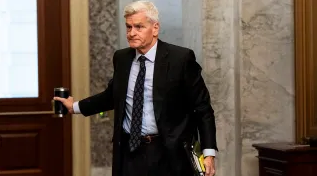
Sen. Bill Cassidy (R-La.), who lost his primary in May to Trump-backed Rep. Julia Letlow (R-La.), was among the Republicans on the Senate Health Committee who rejected Jim O’Neill, a science and technology investor and Trump’s nominee to lead the National Science Foundation, on Wednesday.
Cassidy, who has become a fierce critic of Health and Human Services (HHS) Secretary Robert F. Kennedy Jr., said the vote to advance O’Neill had been canceled due a lack of support.
O’Neill “did not do enough to stand up for science and against irresponsible decisions and statements” from Kennedy, Cassidy said. He noted he was not the only committee member who harbored such concerns.
“I like Jim personally, but this time requires leadership and fortitude and standing up for what is right,” Cassidy said.
Prior to O’Neill, Cassidy had voted to advance every Trump health nominee who appeared in front of his committee, overcoming any misgivings.
Cassidy also had concerns about Heidi Overton, Trump’s nominee to lead the Food and Drug Administration, but seemed ready to vote for her anyway until the White House suddenly withdrew her nomination the night before her scheduled hearing.
Cassidy’s relationship with the president has been complicated. The Louisiana senator voted to convict the president in 2021 following the Jan. 6, 2021, Capitol attack, but has tried to show he is still loyal, including by casting the deciding vote to confirm Kennedy as HHS secretary.
But since he lost his reelection bid, Cassidy has repeatedly clashed with Kennedy.
In an interview on “Face the Nation” on Sunday, Cassidy called Kennedy’s tenure at HHS “a series of failures,” although he stopped short of saying he regretted his vote for the secretary.
Cassidy, as a committee chair, is uniquely positioned to intervene on controversial nominees.
But the structure and traditions of the Senate allow individual senators who want to make a statement to exert significant influence. That could foreshadow more pushback from outgoing Republicans, who have little left to lose, on Trump policies and people.
Sen. John Cornyn (R-Texas) recently used his power as a home-state senator to disapprove of T. Elliot Gaiser, a Trump nominee to be a district judge in Texas.
Cornyn said he opposed Gaiser because he is not from Texas and does not have trial experience.
Cornyn’s office said he had recommended another nominee to the administration months ago.
He then did not submit a “blue slip,” which is essentially a stamp of approval from a senator for judicial nominees in their state.
“I just refuse to be jammed by a non-Texan who has no trial experience, who hasn’t been vetted,” Cornyn told CNN this week. “And so, we provided the White House an alternative, and I’m hoping they take advantage of it because I don’t want the seat to go vacant either.”
Gaiser’s nomination will likely not go forward without Cornyn’s approval.
The move has garnered the outgoing senator plenty of criticism from others on the right, including Heritage Foundation President Kevin Roberts, who lambasted Cornyn online for the move.
“John Cornyn is going out as the Republican Texas Senator who helped get radical leftist James Talarico’s agenda started early. What a legacy,” Roberts wrote on social media Thursday, responding to a news article about the Gaiser nomination.
He earned a sharp reply back from Cornyn: “Kevin, your sycophancy has destroyed the credibility of a once great institution, and in so doing you have made yourself irrelevant.”
A third Trump pick is also likely to not advance further, after retiring Sen. Thom Tillis (R-N.C.) placed a hold on Michael LoSapio, nominated to be the new director for the Cybersecurity and Infrastructure Security Agency.
Tillis objected to LoSapio after the nominee said in his confirmation hearing that the Capitol was not attacked on Jan. 6, 2021.
