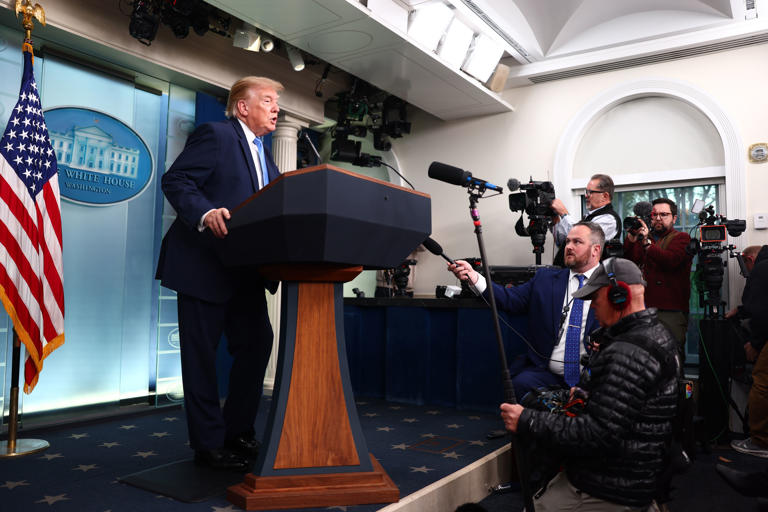
The United States is unlikely to restart major military operations against Iran, President Donald Trump indicated Monday, saying he was satisfied that current negotiations were making progress and that there was little need for now to engage in an extensive new attack.
“Iran, militarily, is effectively over. We’re just keeping it the status quo, and we’re doing that really at the behest of countries that are their neighbors,” Trump told reporters in a surprise appearance in the White House briefing room, hours after meeting Qatari Prime Minister Mohammed bin Abdulrahman Al Thani, who has been serving as an interlocutor between Tehran and Washington.
“Taking the military action doesn’t seem to be a very necessary thing,” Trump said. “But we’re locked and loaded, ready to go, for any reason that changes.”
Get Early Brief newsletter
The biggest political news to start your morning. Sign up for free
His remarks were his most explicit acknowledgment that he hopes to put the Iran war on hold since voters battered Republicans in midterm elections over economic concerns tied to the eight-month-old conflict. But even as the president said he did not see the need for fresh operations that could invite Iranian retaliation and drive energy prices higher, he said the war had been “won,” embracing a conflict that remains deeply unpopular among American voters.
The Feb. 28 invasion of Iran sent oil prices skyrocketing and drove up prices at the gas pump after Iran effectively shut down the Strait of Hormuz, a major chokepoint for shipping oil out of the Persian Gulf to global markets. More recently, oil flows have revived under heavy military protection from the U.S. Navy, but prices have remained stubbornly high, driving a wave of indignation toward a president who campaigned on a promise of keeping prices low and not starting any new wars in the Middle East.
Trump said ahead of the midterm election that he believed that Tehran would quickly capitulate after Americans voted and that the Iranians were holding out to try to cause maximum pain to consumers and damage him politically. He built up the U.S. military presence near Iran and discussed military options with his advisers for both before and after the election.
But Iran retains a formidable stockpile despite months of intense U.S. and Israeli bombardment, and any fresh major attack could risk a significant retaliation against U.S. forces or American allies in the region.
Trump said Monday that negotiations were making progress.
“They’re talking to us, and they’re talking very politely. And we’ll see what happens. But there’s a good chance that that could get ended,” Trump said. “So, at the conclusion of the military engagement, the American people and the people of the world will be far safer and more secure than they’ve been in many many years, because Iran was killing many people.”
The president rejected an effort to hold the administration politically accountable for the Iran conflict, following speculation that he might be contemplating dismissing Defense Secretary Pete Hegseth. Instead, reacting to a decision by outgoing Rep. Thomas Massie (R-Kentucky) to introduce articles of impeachment against the Pentagon leader, Trump said that he had “won two wars,” one of which was Iran.
Vice President JD Vance last week broke publicly with the president over his handling of the Iran war, saying that the conflict was one of the main reasons the Republican base abandoned Trump and voted for Democrats. The unusual internal dissension — which Trump said he agreed with, even as he defended his decision-making — made clear how difficult it would be for Trump to restart the war, seemingly against the objections of his own second-in-command.
Instead, the U.S. military has announced smaller operations, including a fresh effort on Saturday to disrupt Iran’s overland transport routes.
