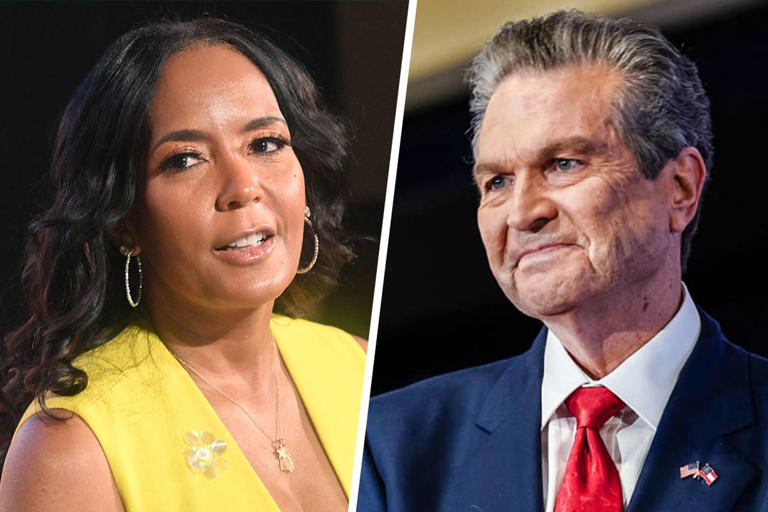
Democrat Keisha Lance Bottoms and Republican Rick Jackson clashed Tuesday night during their only scheduled debate of this fall’s race for governor in Georgia, taking aim at one another on economic issues, data centers and President Donald Trump.
Public polls show Bottoms, the former mayor of Atlanta and a former Biden administration official, and Jackson, a billionaire healthcare executive, locked in a close race four weeks out from Election Day, and with early voting kicking off next week.
The hourlong, town-hall style debate was largely civil, featuring live and taped questions from voters. Though Jackson frequently ripped his opponent over her record as mayor, while Bottoms attacked her rival’s praise of Trump.
“My opponent has said he wants to be Trump’s favorite governor. He wants to be Trump with a southern tone. He said there’s not a single policy that he disagrees with Trump on,” Bottoms said at one point, responding to a question about the Trump administration’s cuts to federal funding.
“I will stand up to Donald Trump when necessary. I’m not running to be his favorite governor,” Bottoms continued.
Jackson responded to that attack by saying, “I don’t owe anybody anything” and that “nobody’s ever told me what to do.”
He then invoked the Brian Kemp, Georgia’s popular, term-limited governor — the first of multiple times he did so.
“I will stand up to anybody, just like Brian Kemp has done. He works with both parties, both presidents, and he stands up when he disagrees,” Jackson said.
Trump endorsed Jackson’s rival, Lt. Gov Burt Jones, during the Republican gubernatorial primary. But Jackson still attempted to claim the MAGA mantle and leaned heavily into comparing himself to the president. Since winning the nomination in June, he’s backed off that approach and sought to link himself more to Kemp, who had also backed Jones.
Jackson, for his part, took several shots at Bottoms over her tenure as mayor, accusing her of being responsible for regional inflation in the Atlanta area he claimed exceeded national inflation rates and pointing to higher crime rates in the city during the Covid-19 pandemic.
“This is the kind of policy that we cannot have in running Georgia. Not having people feeling safe to go to work,” Jackson said. “Bad mayors don’t make good governors.”
While the candidates were asked about housing and education, the event predominantly focused on economic issues and affordability, with both candidates repeatedly pressed on how they’d bring down costs. Both focused heavily on tax relief.
Bottoms emphasized her proposals to cut or suspend state or local taxes on a raft of items like auto insurance, groceries, hygiene products and diapers. Jackson, in turn, reiterated his promise to cut state income taxes, property taxes and taxes on certain utilities.
Data centers and the controversial surveillance traffic cameras known as Flock cameras also took center stage.
On data centers, Bottoms repeated her desire to implement a pause on new construction. Jackson said he wouldn’t approve new construction as governor without first getting local community approval, establishing environmental standards and receiving a commitment that the power bill of local communities would be reduced.
But the two sparred on the issue, as well, with Bottoms accusing Jackson of investing in data centers and Jackson accusing her of having approved the construction of them as mayor.
Bottoms also said she wasn’t opposed to a moratorium on the installation of new Flock cameras, while Jackson said he was.
The issue of election security — which has hung over Georgia politics for six years — also came up.
Bottoms said she was “deeply concerned about Donald Trump’s rhetoric around our elections.”
Jackson, however, when asked whether he thought the U.S. Justice Department should be “overseeing and getting involved” with the state’s elections, deferred to the sitting governor again.
“I don’t think that’s necessary unless Gov. Kemp thinks it’s necessary,” Jackson said.
Jackson has flooded the airwaves with ads, using tens of millions of dollars of his own money to outspend Bottoms 7-to-1 as of last week.
That disparity has worried many Democrats, who’ve seen this year as a prime opportunity to flip the governorship blue for the first time in 16 years.
Aiding Bottoms is the broader political environment in Georgia and nationally: Trump is facing negative approval ratings and voter concerns with his administration’s handling of the economy.
