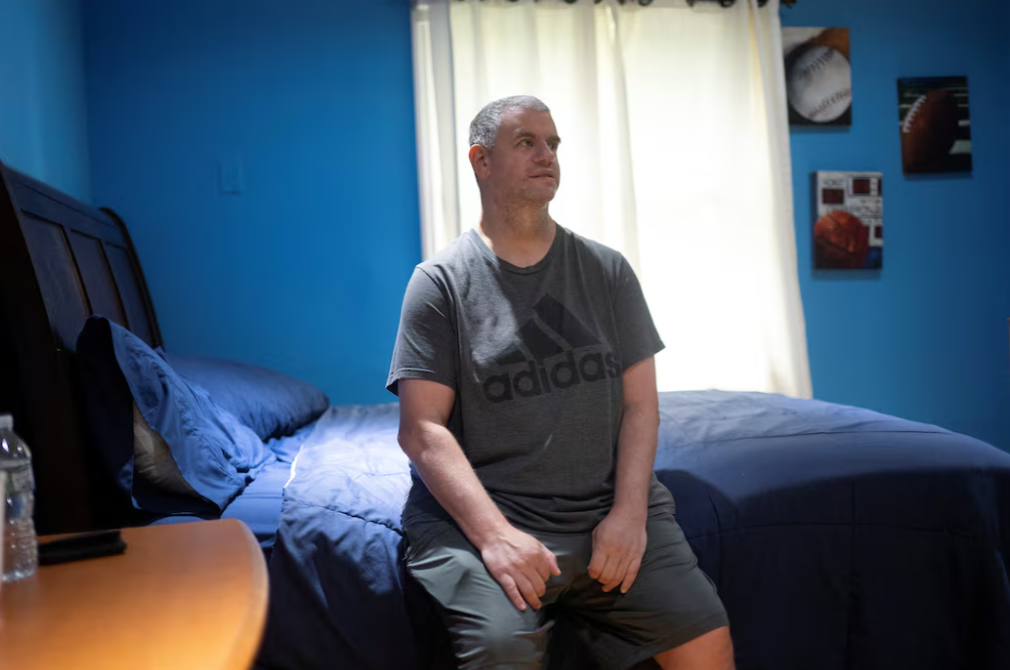
Richie Rosen, 43, was born with a rare genetic condition called Williams syndrome. His hands are weak and unreliable. He longs for human connection but gets anxious in social situations and is easily upset.
For four years, a Haitian caregiver named Tassy helped him navigate day-to-day life at a group home for developmentally disabled men in upstate New York – cooking for him, driving him around and making difficult chores more manageable.
But on July 27, Jawonio, the nonprofit that runs the facility, terminated Tassy’s contract after the Trump administration ended Temporary Protected Status for Haitians and the work authorization that came with it.
“I miss him a lot,” Rosen told Reuters last week, sitting in his room at the home in Rockland County, a leafy suburb north of New York City. “I miss him just saying hi to me all the time.”
Around 21,000 of the 330,000 Haitians in the United States under TPS worked as caregivers and nursing assistants as of last year, serving around 77,000 patients, according to an analysis of U.S. census data by Philip Connor, a research fellow at Princeton University.
Their abrupt removal from the healthcare industry has placed additional strain on a system already struggling to meet the needs of the fast-aging U.S. population. It also came as a shock to families that relied on them.
Richie’s mother, Sharan Rosen, said Tassy was “like family” to her son, who never got the chance to say goodbye to his longtime aide.
“My heart is breaking for him and for my son,” she said.
Reuters was unable to reach Tassy for this story and is using only his first name due to his vulnerable legal status.
Jawonio was forced to lay off nearly two dozen Haitians last month, totaling 7% of its staff. Most of those affected provided round-the-clock care for disabled patients for around $20 per hour, just a few dollars above New York’s minimum wage.
“These are among the most difficult positions to fill,” Jawonio’s CEO, Randi Rios-Castro, told Reuters in response to emailed questions.
“This has never been just an immigration issue,” she wrote of the decision to end TPS. “It is a healthcare workforce issue for us and our country.”
‘PATIENT CARE SUFFERS’
The United States granted humanitarian protection to Haitians following a devastating earthquake in 2010.
The Trump administration cited improving conditions in Haiti as a reason for ending the program, though the country remains among the most unstable in the Western Hemisphere.
Haiti has not held elections since 2016; its last president was assassinated in 2021. Gang violence, opens new tab has convulsed the capital. 1.4 million people are displaced from their homes, the U.N. said, opens new tab last year, and about 6 in 10 live in poverty.
No longer able to legally work in the United States, former TPS holders can now return to Haiti voluntarily — or try to stay in the U.S. and risk arrest and deportation.
