Don’t be surprised if you start hearing some more coughing in the next few weeks. COVID-19 is once again on the rise in nearly every corner of the U.S.
According to modeling done by the Centers for Disease Control and Prevention, “COVID-19 infections are growing or likely growing in 50 states.” No states are seeing cases decline, as of mid-August.
Despite the trend, the CDC says severe cases are still pretty rare. Emergency department visits related to COVID are “very low.”
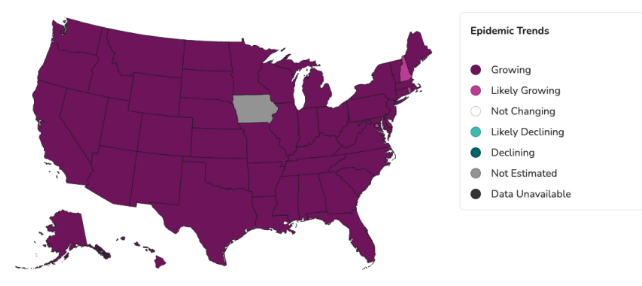
(Epidemic trend tracking by the CDC shows COVID ‘growing’ or ‘likely growing’ in every state. No estimate was given for Iowa. )
Wastewater data can give us a closer look at where the virus may be circulating most. Testing the sewage can pick up the presence of COVID-19 in a community and “can pick up signs of infection even from people who feel perfectly healthy,” the CDC says.
Two states show signs of elevated viral activity. Hawaii and Mississippi are both listed as having “moderate” levels of COVID-19, though wastewater data for Mississippi is limited.
House Ethics Committee investigates Democrat Rep. Jimmy Gomez for alleged sexual misconduct
The West and South are seeing higher levels of COVID activity than other regions. Alabama, Alaska, California, Florida, Georgia, Oregon, Nevada, Texas and Washington all have “low” levels of COVID in wastewater, while the rest of the states are classified as “very low.”
The CDC also tracks levels of two other respiratory viruses, influenza and RSV. Both are showing up less frequently in wastewater than COVID-19 is.
An updated COVID-19 vaccine targeting the prevalent XFG variant is expected to be available starting in the fall.
