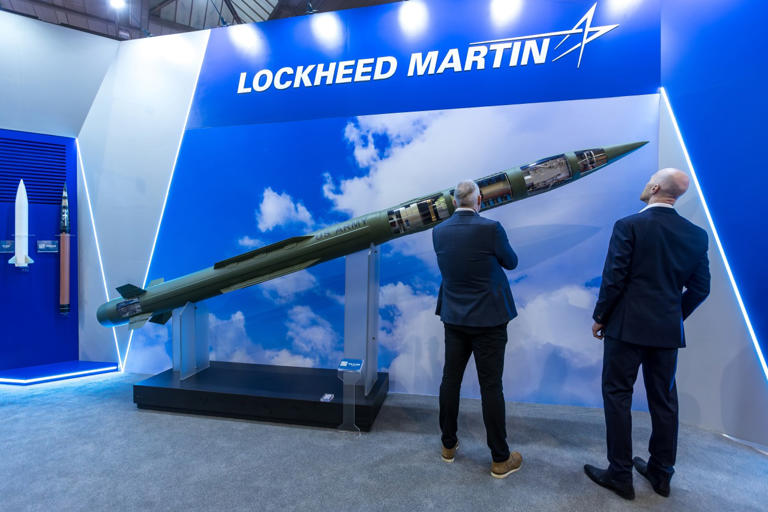
The Pentagon on Wednesday earmarked more than $120 billion for contractors to step up production of Patriot missiles and long-delayed submarines to support future combat operations.
The Patriot contract with missile maker Lockheed Martin is now valued at nearly $59 billion, a significant expansion of an order announced in April.
General Dynamics Electric Boat and HII Newport News Shipbuilding received a $76.6 billion deal for nine Virginia-class and five Columbia-class nuclear submarines that will be delivered by 2038.
Replenishing munitions stockpiles and increasing shipbuilding capacity are top Trump administration priorities, and have been pain points for the U.S. military. Congress must still provide annual funding for the deals.
The modified Army contract for more Patriot missiles also comes as demand surges for the defensive weapon used heavily during the Iran war and in Ukraine.
Lockheed has another megadeal for missiles on order with the U.S. government—a preliminary $35 billion multiyear contract for Thaad interceptors, a larger munition also capable of thwarting ballistic missiles.
Both contracts, which span seven years, reflect the Pentagon’s changing approach to buying missiles. The military has proposed a series of multiyear agreements instead of annual purchases to guarantee a smoother supply of weaponry over time.
The effort, launched last year under Deputy Defense Secretary Steve Feinberg, is designed to motivate contractors to invest in new factories and supply-chain agreements in exchange for a reliable signal of future orders.
The recent deals for Patriot and Thaad missiles are undefinitized contracts, meaning they lack the backing of full congressional funding. Democrats and some Republicans have expressed skepticism about the Trump administration’s unprecedented $1.5 trillion military spending request, though some lawmakers have said they generally support higher spending on munitions like the Patriot.
Trump administration officials were already planning to surge missile production before the war with Iran launched in February added urgency to the issue. The widening conflict in the Middle East has only increased global demand for Patriots, an air-defense system capable of thwarting attacks from cruise and ballistic missiles. The newest Patriots cost around $4 million each and take years to produce.
U.S. and international demand for missiles is boosting the bottom lines of the companies that supply them. Both Lockheed and RTX this month raised their 2026 profit and revenue projections largely on the strength of munitions sales.
Lockheed Chief Executive Jim Taiclet said the company in some cases will invest in weapons it knows customers will need before the orders are set.
“The way we’ve been going about that is to build mission technology road maps that just don’t wait for the next order,” he said during a recent conference call with analysts.
The Navy called the contract for submarines a “once-in a generation recapitalization” of its current fleet. The much-anticipated deal also includes funding for infrastructure improvements at both shipyards.
Submarines are incredibly important to the U.S. military since they are difficult to track and allow commanders to launch covert strikes. The Virginia-class vessels can strike targets on land and ships at sea. Columbia is a new class of submarine that will be able to launch nuclear-armed ballistic missiles.
The multiyear deal is a win for shipbuilders as it allows them to place bulk orders for bespoke parts, like the nuclear reactors that power the submarines and specialized valves and pumps, said Bryan Clark, a naval expert with the Hudson Institute, a Washington, D.C., think tank.
“It’s really important for the supplier base because they’ve been going for a few years without really getting steady orders,” Clark said.
Rep. Joe Courtney (D., Conn.), who represents the district that is home to Electric Boat, said the deal gives suppliers certainty and will allow them to invest in hiring, facilities and equipment.
“Congress and the Navy must now double-down on industrial base investments that are moving delivery schedules to the left,” Courtney said in a statement.
