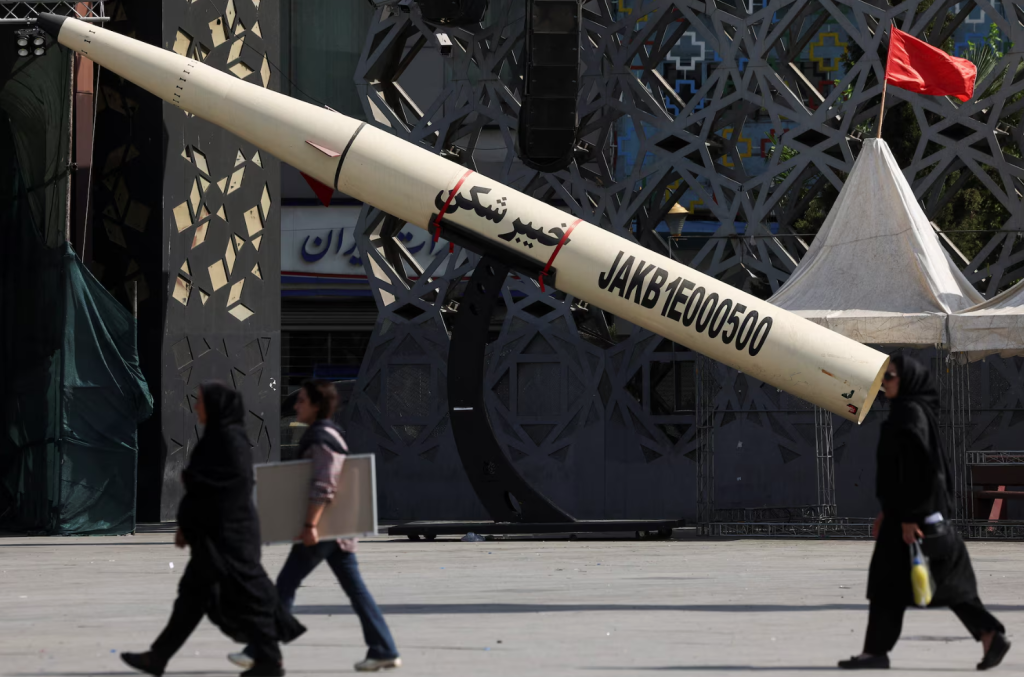
A U.S. air base in Jordan was targeted by Iranian ballistic missiles on Tuesday, Iran’s Islamic Revolutionary Guard Corps said, while calling on Jordanians to dismantle American bases in the kingdom.
“You know very well that not only do we not have any enmity with your country, but we also love you, the noble people, who understand the pain and oppression of the Palestinian people more than any other nation,” the IRGC said in a statement carried by Fars News.
Jordan’s armed forces said on Tuesday they intercepted and shot down four missiles that entered Jordanian airspace from Iranian territory, according to state news agency.
U.S. forces completed their latest wave of strikes on Iran that the U.S. Central Command began earlier in the day at the direction of President Donald Trump.
The five hours of U.S. strikes were the third consecutive night of attacks against Iran as Trump reinstated a blockade of Iranian shipping and proposed charging a 20% fee to guard the Strait of Hormuz.
Iranian media reported strikes on a number of the cities and said four people had been wounded and rescue operations were underway.
Trump earlier told the “Hugh Hewitt Show” on Monday that Iran would be hit “very hard tonight, and we’re going to hit them hard tomorrow. And there’s not a damn thing they can do about it.”
The latest hostilities come after Iran said at the weekend it was closing the Strait of Hormuz, casting further doubt on an interim deal to halt the war and driving oil prices higher.
“The Hormuz Strait is OPEN, and will remain OPEN, with or without Iran. We are reinstating THE IRANIAN BLOCKADE,” Trump had said earlier on Monday on Truth Social.
“The U.S.A. will be, from this point forward, known as ‘THE GUARDIAN OF THE HORMUZ STRAIT’, but as such, and as a matter of FAIRNESS, will be reimbursed, at the rate of 20% on all cargo shipped.”
Iran’s top joint military command said the U.S. had no role in determining the future of the waterway. Iranian Foreign Minister Abbas Araqchi wrote on X that Tehran was the guardian of the strait and would remain so “forever”, adding in response to Trump: “20% is of course too much. We will be fair.”
Before the conflict began in February, around a fifth of the world’s oil and gas traffic passed through Hormuz daily, delivering more than 15 million barrels of fuel to global markets worth at least $1.2 billion. If the U.S. were to impose a 20% fee, it could generate around $240 million a day.
The U.N. shipping agency pushed back against Trump’s proposal, saying it opposes any fees for straits used in international navigation and stressing that there is no legal basis for introducing mandatory tolls on strait transits.
Oil prices rose nearly 3% on Tuesday to their highest in four weeks, as the U.S. reimposed its naval blockade of Iran and the attacks in the Strait of Hormuz heightened uncertainty about energy flows.
