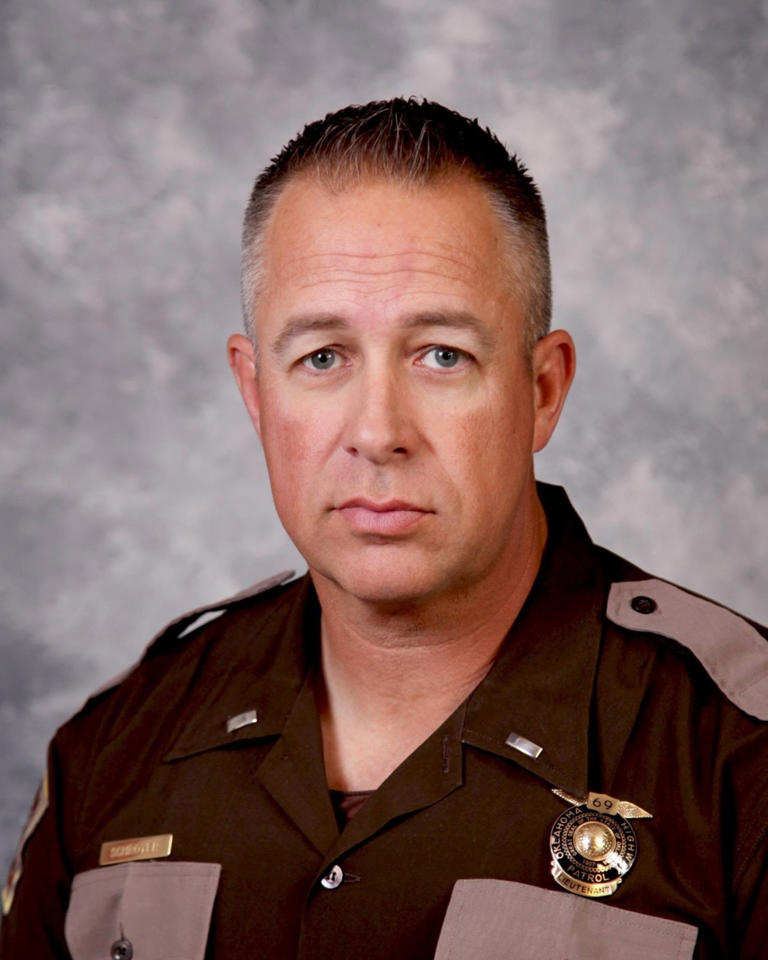
President Trump on Saturday announced that he nominated Lance Schroyer, a veteran of Oklahoma law enforcement, to serve as his next director of U.S. Immigration and Customs Enforcement.
Trump called on the Senate to take up the nomination quickly. If successful, Schroyer would be the first Senate-confirmed ICE director to serve in that capacity since the Obama administration. The position has for years been filled with temporary leaders.
ICE, the primary agency responsible for arresting and deporting immigrants in the country illegally, is at the center of Trump’s promise to carry out a mass deportation. It has been plagued by controversy since the start of his latest term.
Homeland Security Secretary Markwayne Mullin, formerly a senator from Oklahoma, has sought to dial back the agency’s profile since its operation in Minnesota, when immigration officers shot and killed two U.S. citizens in separate incidents. Since Mullin took office, he had advocated with officials in the White House to elevate a law-enforcement official from his home state, who wouldn’t come with an already-charged record in immigration work, according to people familiar with the matter.
Todd Lyons, who was previously acting director of Immigration and Customs Enforcement, oversaw the administration’s migration crackdown before departing last month. He was succeeded by David Venturella, a former private prison executive who is now serving in an interim capacity.
Trump noted that Schroyer and Mullin, both Oklahoma natives, share a similar mindset. “Lance Schroyer has what it takes to DETAIN AND DEPORT Illegal Alien Criminals, including murders, rapists, and drug traffickers at a rate never seen before,” he wrote on social media.
Mullin praised the choice as “a great pick,” writing in a social-media post that Schroyer would be coming “from the operation field where he ran large scale operations” under a program known as 287(G), which allows state and local law enforcement to carry out immigration arrests. In the past few months, ICE has been ramping up 287(G) agreements with state and local police departments in red states across the country. The program is viewed as valuable both as a force multiplier, and a way to carry out arrests in a more low-profile manner, since they are done by local police rather than officers wearing ICE uniforms.
Mullin called Schroyer up to the stage while speaking at the National Sheriff’s Association conference earlier this month. Mullin said that Schroyer, a major in the Oklahoma state highway patrol, had recently joined DHS to advise law-enforcement agencies newly joining the 287(G) program.
“We have him on staff. You guys want to talk to him? You guys want to utilize him, see how he does it,” Mullin said. “He is fully committed and understands that the 287(G) program can be a tremendous asset to you and to the country.”
Officials and field officers at ICE greeted the selection with some confusion, according to people familiar with the matter. Past ICE directors have been police chiefs and high-level prosecutors, more senior positions than Schroyer held in Oklahoma.
Tom Homan, the White House border czar who served as an acting ICE director during Trump’s first term, objected to the pick, according to two people familiar with the matter. A White House official stressed that Homan remains close to Trump’s team and will continue working on immigration policy.
Sen. James Lankford, the senior Oklahoma Republican, celebrated the selection, writing on social media that Schroyer “understands the importance of enforcing our immigration laws and keeping our communities safe.”
