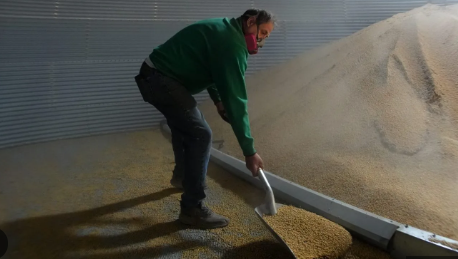
Farmers in the Midwest are struggling under President Trump’s tariffs and rising costs during the Iran war, testing a key GOP voting bloc as the party seeks to hold on to its control of Congress this November.
Trump was overwhelmingly backed by farmers in 2024 — winning all but 11 of 444 farming-dependent counties, as defined by the Department of Agriculture. But the president has seen a drop in support from farmers since taking office, with the latest Farm Futures Q1 survey showing confidence in the president down 10 points from the previous survey.
Marc Short, longtime aide to former Vice President Mike Pence and chair of Advancing American Freedom, highlighted this falling support among farmers, noting “Make Our Farmers Great Again” hats were once commonplace at Trump campaign rallies.
“But things are different now,” he wrote in a Washington Post op-ed on Monday. “President Trump’s trade policies have punched farmers in the mouth, and this time there’s no global pandemic to blame.”
“Republicans who continue to ignore this reality do so at their peril,” Short warned.
Fertilizer prices have become a major concern, with 70 percent of farmers saying in a recent poll that they cannot afford all the fertilizer they need. At the same time, farm bankruptcies reached their highest level in six years this April, raising concerns that Trump’s policies could become a political liability for Republican candidates in key Midwestern states this November.
Last year, Trump’s tariffs triggered retaliatory import taxes from many of the country’s largest trading partners, contributing to a sharp decline in U.S. exports. In Canada, one of the top two U.S. trade partners, consumers boycotted some American goods, and U.S. agricultural exports fell by more than $1 billion.
The Trump administration, however, has signaled it recognizes farmers’ concerns. On Monday, the president signed a proclamation lowering tariffs on some aluminum and steel products, including agricultural equipment, from 25 percent to 15 percent.
The president also plans to travel to Wisconsin on Friday to tout his rural initiatives and “to highlight his strong support for Wisconsin’s farmers,” White House spokesperson Liz Huston said in a statement.
“Wisconsin families put their faith in President Trump in 2024, and he has spent every single day since taking office fighting and delivering for them,” Huston said.
The administration previously extended aid to farmers, including in December, when Trump announced $12 billion farmer bridge payments for “American farmers impacted by unfair market disruptions.”
But farmers in Midwestern states are still facing economic challenges, with 94 percent saying in an April survey that their financial situation has worsened or remained the same since last year.
In 2025, 15,000 farms closed, and farm bankruptcies were up 46 percent, after rising by 55 percent in 2024. By this May, according to The New York Times, bankruptcies were up by 70 percent.
Agricultural concerns are becoming a political issue in Nebraska, where independent candidate Dan Osborn represents Democrats’ best chance in the race to unseat incumbent Sen. Pete Ricketts (R).
“The president is historically unpopular right now nationwide,” Nebraska-based GOP strategist Ryan Horn told The Hill in May. “And while that doesn’t affect Nebraska as much — because it’s a very Republican state — the tariff policies and the war in Iran, they are kind of underreported stories, how hard that is hitting rural America.”
Horn noted tariffs have depressed foreign markets for grain, corn and soybeans, while increasing the cost of fertilizer and equipment, since steel is necessary for things like harvesters and rotary irrigators.
The Republican strategist said the economic challenges could become bigger issues going into November, noting “there’s no question” farmers are losing patience with the Trump administration’s tariffs and the rising costs.
“Farmers are frustrated, ag leaders are frustrated. They’re frustrated with these high costs. They’re frustrated with the low commodity prices,” Horn said. “It’s making their lives more difficult. It’s making it hard to turn a profit.”
“Now, will that affect their vote? Will they cross parties in large numbers to vote for someone from the other party? I mean, that’s the big question,” he added. “Will they look at it and say, ‘Donald Trump’s not on the ballot, I blame these tariffs and things, and so I’m going to vote against Pete Ricketts?’ That’s a tough case to make for a campaign.”
A similar problem for the GOP is taking shape in Iowa, where Democrats view the governor’s mansion and outgoing Republican Sen. Joni Ernst’s seat as two key pickup opportunities amid the economic discontent.
“I’m not trying to dodge the fact that the tariffs hurt. What I am trying to tell you is we get it, our farmers get it,” Iowa Republican Party Chair Jeff Kaufmann said, Bloomberg reported.
“My job is to keep the Trump voters voting for us and keep reminding people that things take time,” he added.
Timothy Hagle, a political science professor at the University of Iowa, said the consequences for the general election will depend on the patience of Trump’s voters, especially as rising fertilizer costs become more pressing as farmers prepare to plant crops this summer.
“In terms of the general election, we’re still a long way out, and things can change,” Hagle said.
“If you’re a farmer and you’re dealing with higher prices for fertilizer, or whatever else it happens to be, this is obviously a very personal kind of a thing for you, and so that affects you directly,” Hagle said. “Those are the kinds of things that do often determine what your vote is going to be.”
Hagle said he thinks pro-Trump farmers are receptive to the president’s tariff argument of “short-term pain for long-term gain,” but he said there is a limit to how long farmers can absorb the costs.
“At a certain point,” Hagle added, “as a farmer, you probably can’t make that trade off anymore because you’ve got other things that become more pressing just for your own personal financial stability.”
Hagle noted there currently is a “mixed economy,” with the stock market hitting record highs in the past year, though he said the benefits of those achievements don’t always reach farmers.
“That’s great if you’ve got investments, and I suppose maybe even some farmers do, but usually their financial resources are tied up in machinery and land and things like that,” he added. “So it’s not necessarily something that helps them when it comes time to pay their fertilizer bill.”
