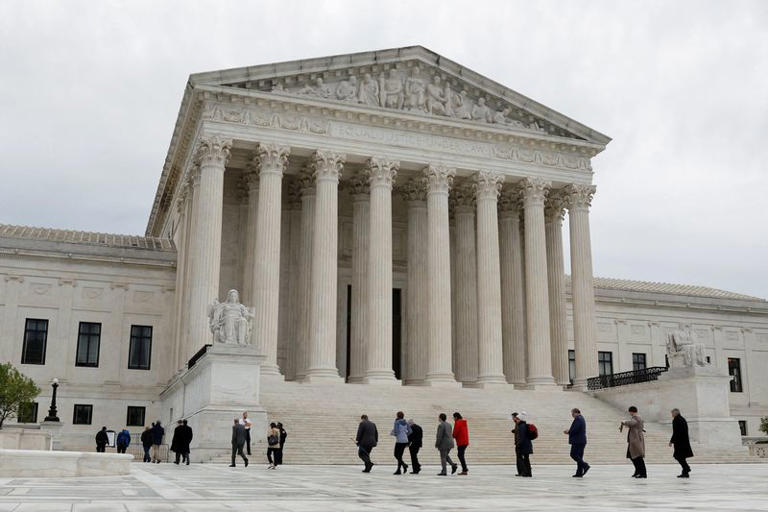
WASHINGTON, May 4 (Reuters) – The U.S. Supreme Court on Monday allowed a recent ruling that gutted a key part of the Voting Rights Act to take effect ahead of schedule, bolstering Louisiana Republicans as they pursue a new congressional voting map ahead of the November midterm elections.
The action by the justices, though procedural, is likely to undercut legal challenges to Louisiana Republicans’ decision to delay the state’s congressional primary elections and seek a new electoral map that could be beneficial to Republicans.
President Donald Trump’s fellow Republicans are fighting to maintain their control of the House, as well as the Senate, in the November elections.
The court’s move, which came in an unsigned order, granted a request from a group of Louisiana voters who described themselves in court papers as “non-African American”. Their lawsuit led to the 6-3 ruling on April 29 striking down an electoral map that had given Louisiana a second Black-majority U.S. congressional district. The ruling gutted a key provision of the Voting Rights Act that had barred electoral maps if they would result in diluting the clout of minority voters.
To give the losing side of a decision the chance to ask for a rehearing, the Supreme Court typically waits 32 days before its formal judgment is issued. But the prevailing party can ask the court to issue its judgment more quickly, as the “non-African American” voters did here.
Governor Jeff Landry responded to the court’s ruling by declaring an emergency and announcing he would postpone his state’s congressional primary elections that had been scheduled for May 16.
Landry’s move prompted lawsuits. Some challengers have argued, among other things, that the governor exceeded his authority to declare an emergency because the Supreme Court’s ruling had not yet taken effect.
Liberal Justice Ketanji Brown Jackson dissented from the court’s move to bypass its usual waiting period, saying the decision “has spawned chaos in the State of Louisiana.”
The rapid developments underscored how the court’s decision on April 29, which severely weakened the landmark Voting Rights Act passed in 1965, has injected more uncertainty into what had already been a dizzying national fight over redistricting.
Black people make up roughly a third of the population of Louisiana, which has six U.S. House districts. Black voters tend to support Democratic candidates.
The state legislature in 2024 drew a map with a second majority-Black district in response to a judge’s decision that an earlier map, with just one majority-Black district, illegally harmed Black voters in violation of the Voting Rights Act.
But the Supreme Court ruled that the redrawn map relied too heavily on race, in violation of the constitutional principle of equal protection under the law.
In a process called redistricting, the boundaries of legislative districts across the United States are reconfigured to reflect population changes as measured by the national census conducted every 10 years. Redistricting typically has been carried out by state legislatures once per decade.
Republicans and Democrats have been waging a multistate redistricting fight ignited last year by an unprecedented mid-decade effort by Trump to redraw maps in Republican-led states, starting with Texas.
