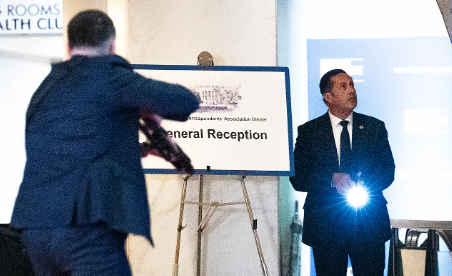
A fresh wave of conspiracy theories is rolling through social media across the country following Saturday night’s attempted assassination of President Trump at the annual White House Correspondents’ Association (WHCA) dinner.
The unfounded theories largely capitalize on short video snippets of those in the room and initial breaking news reports filed moments after a gunman tried to breach a ballroom at the Washington Hilton with Trump and hundreds of other government officials and members of the press inside.
By the time Trump had traveled back to the White House to deliver remarks on the incident and posted a photo of the suspected attacker, thousands of social media posts had been circulating online suggesting the episode was “staged” or somehow faked.
Reasons users cited for such a hoax were wide ranging, from a desire to distract from the Iran war to a need to justify Trump’s desired ballroom at the White House for hosting large events like the annual WHCA dinner.
It’s just the latest example of a real shooting prompting false conspiracy theories. The first attempt on Trump’s life at a Butler, Pa., campaign rally in 2024 also sparked false stories, as did the assassination of conservative political activist Charlie Kirk last year.
Experts on disinformation say breaking news is increasingly becoming a breeding ground for unfounded conspiracy theories in part because people are seeing so many things online that turn out not to be true.
“We’re in an information environment where people are just not believing anything they see because they’ve become so exhausted by the steady tide of information everyone is sharing that later turns out to be not true,” Katie Sanders, editor in chief of the fact checking website PolitiFact, told The Hill. “People might want to tune all of it out, but that means they’re not in a good position to separate what’s true when breaking news happens.”
Kirk’s murder was captured on video that spread quickly online. A man accused of shooting him is standing trial in Utah.
But that hasn’t stopped theories from spreading that Israel was responsible for Kirk’s killing.
Conspiracy theories are also sometimes pushed by figures with large social media followings.
Some of the conspiracy theories about Kirk have come from prominent pundits on the right and at least one former top intelligence official in Trump’s administration, Joe Kent.
State actors are also often responsible for spreading conspiracy theories.
Some social media users on Saturday falsely asserted that the suspect in Saturday’s shooting had Israeli sympathies, a claim that was promoted by the Russian-operated state media outlet RT, The New York Times first reported.
The 2022 attack on former House Speaker Nancy Pelosi’s (D-Calif.) home targeting her husband, Paul Pelosi, sparked days of online conspiracy theories, including from billionaire Elon Musk.
In the weeks that followed the first assassination attempt against Trump in Butler, many online conspiracy theorists alleged that the shooting was staged to distract from negative headlines surrounding Trump’s candidacy at the time.
Such chatter likely “primed” some of the online skepticism that took place after Saturday’s events, Sanders said.
The White House on Monday publicly denounced misinformation circulating online about Saturday’s incident but stopped short of saying what efforts it had taken to work with social media companies to quell the spread of false rumors about the shooting.
