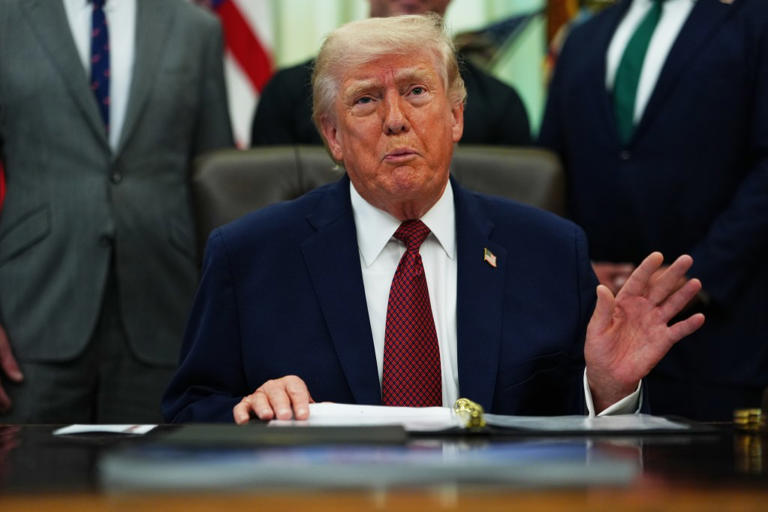
President Donald Trump on Saturday signed a short-term extension of a sweeping federal surveillance program after a chaotic late-night collapse of Republican efforts to pass a longer renewal — kicking a politically explosive debate over privacy and national security to the end of the month.
The stopgap keeps Section 702 of the Foreign Intelligence Surveillance Act alive only until April 30, setting up another high-stakes congressional showdown in a matter of weeks.
Every American whose communications have touched a foreign target is subject to the program’s reach, and critics say the short extension does nothing to address long-standing civil liberties concerns.
What Is Section 702 — and Why Is It Controversial?
Section 702 of the Foreign Intelligence Surveillance Act allows the Central Intelligence Agency (CIA), National Security Agency (NSA), Federal Bureau of Investigation (FBI) and other agencies to collect and analyze vast amounts of overseas communications without a warrant.
In doing so, agencies can incidentally sweep up emails, phone calls and text messages involving Americans who interact with foreign targets — without those Americans ever being notified or charged with a crime.
U.S. officials say the authority is critical to disrupting terrorist plots, cyber intrusions and foreign espionage. Critics, including a rare bipartisan coalition in Congress, want a warrant requirement before authorities can access Americans’ communications gathered through the program.
Past misuse has fueled skepticism. FBI officials repeatedly violated their own standards when searching intelligence related to the January 6, 2021, Capitol attack and the 2020 racial justice protests, according to a 2024 court order.
How the GOP Revolt Unfolded
Trump and House Speaker Mike Johnson spent the week lobbying for a clean 18-month renewal with no changes. CIA Director John Ratcliffe personally spoke with GOP lawmakers, and a group of Republicans traveled to the White House for a Tuesday meeting. Trump posted on Truth Social urging Republicans to “UNIFY, and vote together.” They didn’t.
GOP leaders rushed lawmakers back into session late Thursday for a series of back-to-back votes that collapsed one after another. First, leaders unveiled a five-year extension with revisions — including new limits on FBI queries involving Americans and enhanced criminal penalties for unlawful surveillance — but it failed to satisfy holdouts in either party. A fallback 18-month clean renewal also failed, with roughly 20 Republicans joining most Democrats to block it. Shortly after 2 a.m., leaders agreed to a 10-day stopgap.
“Are you kidding me? Who the hell is running this place?” said Democratic Massachusetts Representative Jim McGovern, during floor debate. Johnson was more measured: “We were very close tonight.”
Republican Tennessee Representative Andy Ogles, a House Freedom Caucus member who helped stall the votes, was blunt. “We warned them that this was gonna happen,” he said. “Unfortunately, here we are at 2 in the morning.”
What Happens Next
Congress now has until April 30 to reach a deal.
Senate Majority Leader John Thune acknowledged the difficulty ahead. “We’ll be preparing accordingly,” the South Dakota Republican said on Friday.
