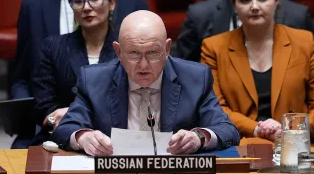
A Bahrain-led resolution aimed at reopening the Strait of Hormuz failed at the United Nations on Tuesday, unable to withstand opposition from Russia and China despite attempts to weaken its provisions to win their support.
Nearly a dozen countries — Bahrain, Democratic Republic of Congo, Denmark, France, Greece, Latvia, Liberia, Panama, Somalia, United Kingdom and the U.S. — voted in favor of the resolution, while Colombia and Pakistan abstained.
However, the veto by Russia and China, both permanent members of the U.N. Security Council, ultimately sank it.
The nations’ leaders were not swayed by warnings from Bahrain’s foreign minister that continued closure of the strait, a key passageway that transports nearly 20 percent of the world’s oil supply, would cause greater economic instability and undermine the Security Council’s authority.
“Such a scenario would inevitably be replicated in other straits and waterways, thereby transforming the world into a jungle where force, arrogance and hegemony prevail and where international laws are utterly disregarded,” Abdullatif bin Rashid Al-Zayani, acting as chair, said ahead of the vote.
The watered-down resolution encouraged “states interested in the use of commercial maritime routes in the Strait of Hormuz to coordinate efforts, defensive in nature, commensurate with the circumstances, to contribute to ensuring the safety and security of navigation across the Strait of Hormuz,” according to The Associated Press.
The original proposal would have authorized countries to use “all necessary means” to ensure transit through the strategic channel and deter attempts to close it — but the language was softened over the course of several days to appease concerns from China, Russia and France about approving the use of force.
The draft, which was voted on Tuesday, eliminated references to Security Council authorization and limited the provisions strictly to the strait rather than extending to adjacent waters. It also demanded that Iran halt attacks on civilian infrastructure in the region and stop interfering with vessels attempting to transit the strait safely.
In explaining his country’s objection, Vasily Nebenzya, Russia’s representative to the U.N., condemned U.S. and Israeli aggression toward Iran and argued the resolution was rife with “unbalanced, inaccurate and confrontational elements.”
China argued the language of the resolution was one-sided and “highly susceptible to misinterpretation or even abuse.”
“At a time when the United States is openly threatening this very survival of a civilization, the current hostilities imposed on Iran is very likely to further escalate,” said Fu Cong, China’s U.N. representative.
Shipping traffic through the critical maritime choke point has been stymied for more than five weeks as Tehran seeks to use it as a bargaining chip to end the conflict.
The de facto blockade, coupled with escalating attacks on energy infrastructure in Iran and neighboring Persian Gulf countries, has raised fears of prolonged fuel and food supply disruptions and inflationary pressures on the global market.
The conflict has pushed the price of Brent crude oil, the international benchmark, repeatedly above $100 per barrel. The World Food Programme has also estimated that 45 million more people could fall into extreme hunger if it does not end by June.
Mike Waltz, the U.S. ambassador to the U.N., slammed Russia and China’s opposition to the resolution as “a new low” and accused Tehran of “holding the global economy at gunpoint.”
“I will note today’s result does not restrict the United States to continue to act in its own self-defense and in the collective defense, and President Trump will continue the actions necessary to defend our people and the free world,” Waltz said.
Trump has given the Iranian regime until 8 p.m. EDT Tuesday to make a deal that would reopen the strait, threatening to unleash “all Hell” on the country by striking bridges and power plants if his deadline is not met.
“A whole civilization will die tonight, never to be brought back again. I don’t want that to happen, but it probably will,” the president wrote in a Truth Social post Tuesday morning, despite warnings that strikes on civilian infrastructure could violate international law.
Iran’s ambassador to the U.N., Amir Saeid Iravani, pushed back against Trump’s threat during the Security Council meeting Tuesday, insisting the country will retaliate against any attacks.
“There must be no doubt Iran will take all necessary measures to defend its people, safeguard its sovereignty and territorial integrity and protect its vital national interest with full resolve,” Iravani said. “The United States and the Israeli regime will bear responsibility for all subsequent consequences, regional and international.”
Iran has defiantly refused a plan for a temporary ceasefire, dismissing the proposal as “unrealistic” and demanding a permanent end to the hostilities.
