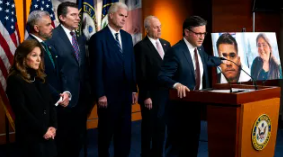
President Trump’s reversal in pushing lawmakers to renew the nation’s warrantless spy powers is putting pressure on the House GOP and some of the tool’s most fervent critics to back its reauthorization.
Section 702 of the Foreign Intelligence Surveillance Act (FISA) allows the government to spy on foreigners located abroad. But the tool has long been challenged by the GOP’s right wing as well as privacy-minded liberals who say the intelligence community should get a warrant before reviewing information on Americans that get swept up if they communicate with those surveilled.
But hardline warrant backers have softened their tone in recent days, even as wrangling over the bill pushed GOP leadership to delay its plans to bring FISA 702 to the floor next week.
While several hardliners in the past swiftly threatened – and then followed through – on a pledge to vote against FISA 702 if a warrant requirement wasn’t added, this year, many are not making such firm commitments.
One leader of the movement, House Judiciary Chair Jim Jordan (R-Ohio), reversed course this week, saying he would support Trump’s request for a clean reauthorization.
“The president indicated that he wanted a temporary reauthorization, and in light of the facts and the changes and reforms we made…we got no problem extending for 18 months, short-term extension,” he said, citing some 50 reforms made to Section 702 when he last voted against reauthorizing it.
Trump has also shifted course, backing the extension even though in 2024 he called on Republicans to “KILL FISA.”
A Section 702 reauthorization will not be an easy lift. Some Republicans, like Reps. Lauren Boebert (R-Colo.) and Anna Paulina Luna (R-Fla.) have threatened to vote against the bill, particularly if the House doesn’t first approve Trump’s new voter ID bill. Boebert added that while she is “a NO on FISA as it stands,” she “MIGHT feel differently” if the SAVE America Act passes.
Several other lawmakers who were vocal in their plans to vote against reauthorization without a warrant last time said they have not yet decided how they will vote, even as they expressed reservations about renewing it.
“We keep finding out over and over and over again that the FBI misused and abused its authority against American citizens. So I’m really struggling with that – they used [another authority under] FISA to actually spy on President Trump, and so I’m kind of bummed by that,” said Rep. Andy Biggs (R-Ariz.), who has repeatedly sponsored legislation to require a warrant before looking at any information collected on U.S. citizens.
But he declined to say how he would vote this year.
“I’m not gonna whip to you, because I don’t whip to those guys either,” he told The Hill.
Rep. Thomas Massie (R-Ky.) said he still plans to vote against Section 702 without an added warrant requirement but said Trump’s push for a straight reauthorization would undoubtedly shift some colleagues.
“It’ll be interesting to see who changes their mind because we have a different president,” Massie told The Hill.
“Now it’s Kash Patel who’s spying on Americans without a warrant. And so it’s fashionable, I guess,” he said, referring to the FBI director, who was a top FISA critic prior to entering the administration.
One GOP staffer said it’s clear Trump is having an influence.
“No one’s gonna cross Trump publicly and loudly. Biggs would be the most likely to, but he’s running for governor,” the staffer said.
“When is Andy Biggs ever been known to be quiet? When is he ever like ‘Eh I’m not going to say what I feel?’”
Rep. Chip Roy (R-Texas), another leading voice pushing for a warrant requirement who did not support Section 702 renewal in 2024, also declined to say how he’ll vote this time though he did stress the need for changes.
“We’re all talking about what we’re going to do. But I’m not going to negotiate this through the media, but we need to see further reforms,” he told reporters Thursday.
“It’s obviously influential and important, and we’re all united wanting to go after our enemies…But at the end of the day, you know, I hear this thing about, well, if we don’t do this, there’s going to be, you know, bloodshed. Well, there was bloodshed to protect the Fourth Amendment,” Roy said.
“We have different occupants of the White House, different occupants in the intelligence community, over time. But the Fourth Amendment stays consistent, and we need to protect it.”
Roy, too, is in a competitive race for Texas attorney general, advancing to a primary run-off.
Rep. Darrel Issa (R-Calif.), another member who voted against reauthorizing Section 702 after the warrant amendment failed, expressed reservations and said he wanted to further analyze whether the limitations included in the 2024 bill were making a difference.
That included shrinking who could query the 702 database and requiring sign-off from a superior before reviewing any information collected on Americans. Congress also now has a greater oversight role in reviewing when information on Americans is accessed.
The reforms, coupled with a tech fix that ended the practice of immediately opting officers into searching the database, have seen searches of Americans drop 2.9 million in 2022 to just over 9,000 in the year after the last renewal of Section 702.
“The president must have more faith in his FBI and Department of Justice, and I understand that, but I don’t have faith in the future FBI and Department of Justice based on the past,” he said.
“I don’t know what the breakdown will be, but certainly a Republican president saying, ‘Please give me a clean reauthorization,’ has more effect on Republicans than Democrats. But at the end of the day, I saw what [Presidents] Obama and Biden did, which was criminal, and they got away with it. And so the incredible amount of violations we’ve seen in the past has been reduced, but I still want to see how much what we already did has as an effect,” Issa said, describing himself as “open minded” while he’s evaluating the impact of the reforms.
Trump is known to pressure lawmakers and in the past has threatened to support primary opponents of the members of Congress who don’t support his legislative priorities.
Massie, who has seen Trump do so in his primary, said he expects the president to give some members a “hall pass.”
“They’ll get as many votes as they need, and they’ll leave some room for people to be principled,” he said, pointing to people more at risk in their districts.
Those who “could endanger their reelection by being on the wrong side of this – those people get a hall pass,” Massie said.
One GOP lawmaker who supports reauthorizing FISA 702 said they haven’t yet seen the push from the White House they’d like, questioning whether colleagues feel presidential pressure.
“There’s not a concerted effort to push, there’s no lobbying effort, there’s no organization. There’s nobody to go to to ask FISA questions,” the lawmaker said.
“I still think there’s a long ways to go to getting this done. Just because Jim Jordan is on board doesn’t mean that these other people are going to be on board,” they said, adding that there are still 30 to 50 lawmakers who might be tough to get to support Section 702.
Trump administration officials this week held a closed-door briefing for lawmakers and publicly pushed for Section 702’s reauthorization during the annual Worldwide Threats hearings.
“The President is in favor of an 18-month, clean reauthorization of FISA 702,” CIA Director John Ratcliffe told lawmakers. “I wish the reauthorization was longer than 18 months.”
Patel chimed in later that he’d love to see an extension of as long as five or 10 years.
For those who backed Section 702’s renewal in 2024 even when Trump did not, the president has earned some praise for now calling for its renewal.
“I just applaud the president’s boldness and his showing leadership on this issue. It’s super important, and he knows it. My only complaint is that we’ve somehow settled on 18 months,” said Rep. Dan Crenshaw (R-Texas), who last year led the charge to expand Section 702 so that it could be used to monitor drug cartels.
“We need it to be a longer reauthorization.”
