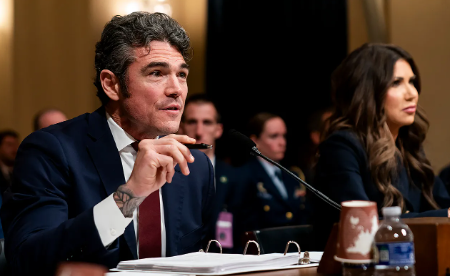
Joe Kent’s resignation from the National Counterterrorism Center over objections to the U.S. war in Iran is putting a spotlight on divisions in the GOP and President Trump’s MAGA coalition.
Until Kent’s resignation on Tuesday, criticism of Trump’s foreign policy moves and strikes in Iran had largely come from the usual GOP congressional gadflies, or right-wing commentators like Tucker Carlson and Megyn Kelly.
But the stunning resignation by a senior political appointee suggests some of the divisions are internal.
“It’s bigger than any resignation that happened under Biden for Gaza,” said Curt Mills, editor of The American Conservative magazine, which argues for restraint in foreign policy. Mills previously supported Trump.
“Joe Kent is not a nobody. He’s one of the most prominent people in the government,” Mills said. “Usually when people resign in protest, you hear their name for the first time. Plenty of people have heard Joe Kent’s name before.”
Kent emerged on the national political scene in 2021 as a Trump-endorsed congressional challenger who defeated then-Rep. Jaime Herrera Beutler (R-Wash.) in a primary. She had voted to impeach Trump after the Jan. 6, 2021, attack on the Capitol. Kent had strong support from former Reps. Marjorie Taylor Greene (R-Ga.), who now regularly criticizes Trump for not being “America First,” and Matt Gaetz (R-Fla.).
While he lost the general election to Rep. Marie Gluesenkamp Perez (D-Wash.), Kent — a former Green Beret and widower whose Navy cryptologist wife died in a 2019 ISIS bombing in Syria — became known in part for ripping into the “military industrial complex” and his skepticism of foreign intervention.
He unsuccessfully sought the Washington congressional seat again in 2024, and was rewarded with his appointment to a position within the Office of the Director of National Intelligence in what was largely interpreted as a signal of Trump appealing to the noninterventionist wing of his coalition.
Rep. Warren Davidson (R-Ohio), who supported a resolution limiting Trump’s war powers in Iran, said he thinks Kent is “a good guy” and has “been a tremendous fighter for doing the right thing.”
“I was surprised by his resignation,” Davidson said, declining to elaborate on what the departure means for the MAGA movement and Republican coalition.
Most Republicans, however, dismissed Kent’s fiery resignation letter, in which he asserted that “Iran posed no imminent threat to our nation” and that the U.S. “started this war due to pressure from Israel and its powerful American lobby.”
Rep. Brian Mast (R-Fla.), chair of the House Foreign Affairs Committee, downplayed Kent’s prominence.
“I never heard of him before today’s news,” Mast said. “Never crossed paths with him, never heard from him, never spoke to him, never one thing about him.”
Sen. Tom Cotton (R-Ark.), the chair of the Senate Intelligence Committee, who backed Kent’s nomination for the post in late July, thanked Kent’s family for their service, but he disagreed with Kent’s argument that Iran was not an imminent threat to the U.S.
“I disagree with his misguided assessment. Iran’s vast missile arsenal and support for terrorism posed a grave and growing threat to America,” Cotton said in a statement. “Indeed, the ayatollahs have maimed and killed thousands of Americans. President Trump recognized this threat and made the right call to eliminate it.”
White House press secretary Karoline Leavitt called Kent’s claims about the threat of Iran “false” and said the allegation that Trump made his decision to strike Iran because of pressure from Israel were “insulting and laughable.”
Director of National Intelligence Tulsi Gabbard — known for her previous staunch opposition to U.S. foreign intervention and against military action in Iran — released a careful statement in the wake of Kent’s departure that did not directly mention Kent, but it said Trump concluded Iran posed an imminent threat to the U.S. and that he “took action based on that conclusion.”
“As our Commander in Chief, he is responsible for determining what is and is not an imminent threat, and whether or not to take action he deems necessary to protect the safety and security of our troops, the American people and our country,” Gabbard said in the statement, which also did not say U.S. intelligence itself indicated Iran represented an imminent threat.
Gabbard has been in touch with the White House since Kent’s resignation, an administration official speaking on condition of anonymity told The Hill on Tuesday.
Kent was not involved in the administration’s briefings ahead of the decision to launch strikes on Iran, and Gabbard was not at any point asked by the White House to fire him, the official said.
Javed Ali, counterterrorism director on the National Security Council during Trump’s first term, said Kent’s resignation is a “major” development since his decision is based on “principle over his policy disagreement with the Iran war, rather than for performance in his position.”
“Kent’s background as a seasoned combat veteran with multiple deployments in Iraq and Afghanistan gave him a unique perspective as director, and over the past year he aligned some of the center’s work to focus more on President Trump’s priorities against drug cartels and transnational gangs that have been formally designated as foreign terrorist organizations under U.S. law,” Ali told The Hill on Tuesday.
Ali, now a professor at the University of Michigan, said it was unclear whether other senior officials holding Senate-confirmed roles will “likewise resign because of their similar disagreement with the Iran war, or whether Kent will be the only one to do so.”
The resignation did not appear to unnerve Trump, who on Tuesday said Kent “seemed like a pretty nice guy” but was “very weak on security.”
Trump has brushed off criticism from those who used to be his staunchest supporters and allies over the Iran war. On Sunday, for instance, Trump said those attacking radio host and Fox News commentator Mark Levin — who had been extremely supportive of the Iran strikes — “ARE NOT MAGA, I AM.” Levin’s critics include Megyn Kelly and Tucker Carlson.
Beyond the political fractures, Kent’s resignation is raising concern about U.S. preparedness during wartime. Colin P. Clarke, the director of policy and research at the Soufan Group and a counterterrorism expert, said he wasn’t surprised by Kent’s resignation over his opposition to the Iran war, but he emphasized that the post needs to be filled immediately with an experienced official.
“The U.S. has scaled back on counterterrorism resources for years now, it’s something I’ve repeatedly warned against, as budgets are slashed, agencies are shuttered and personnel are moved to other priority areas for this current administration, including immigration enforcement. The threat is spiking at the same time that the country is woefully unprepared to deal with it,” Clarke told The Hill.
