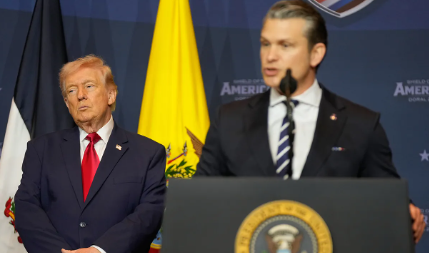
President Trump and the Pentagon are offering conflicting signals on how long the U.S. war with Iran will last, as officials in Tehran prepare to dig in for a longer fight and with the economic fallout from the clash hurting the U.S. and global economy.
Trump on Monday suggested victory is in sight but with the caveat that the U.S. is not yet done hammering Iran.
“We’ve already won in many ways, but we haven’t won enough,” he said at a press conference at his Doral resort in Miami.
He also stressed Washington is “achieving major strides toward completing our military objective, and some people could say they’re pretty well complete.”
He listed off claims the U.S. military has wiped out Iranian forces, sunk its navy, destroyed its air force, targeted its drone and missile capability and disabled its radar and antiaircraft equipment.
Asked how long the U.S. military “excursion” into Iran will last, Trump says it will end “soon,” but not this week.
The Pentagon, however, was sounding a different tune earlier Monday.
“We have Only Just Begun to Fight,” a Pentagon-run social media account posted Monday alongside a picture of a launched missile with the words “No Mercy” superimposed over it.
“This is just the beginning—we will not be deterred until the mission is over,” an earlier post from the same account read, this time alongside a video of various strikes on what appeared to be Iranian targets. The U.S. military so far has struck more than 5,000 Iranian sites.
Trump in recent days has signaled the war could soon come to an end after he demanded last week the country’s “complete and total surrender” and warned the U.S. could widen its attacks.
In a Monday interview with CBS News just before his press conference at Doral, Trump said the war “is very complete, pretty much,” claiming that Iran has “no navy, no communications, they’ve got no air force. Their missiles are down to a scatter. Their drones are being blown up all over the place, including their manufacturing of drones.”
That also differs from Trump suggesting last week that the war, which has entered its ninth day, could stretch to four to five weeks.
Public sentiment concerning the war continues to wane, imposing big political risks for Trump in a midterm year that are surely on his mind.
A majority of registered voters, 54 percent, disapprove of Trump’s handling of Iran, according to an NBC News poll conducted in the early days of the war. Forty-one percent of respondents said they approved of Trump’s handling of the situation. In other surveys, Americans have expressed opposition to the military action on Tehran altogether.
Trump and his administration have offered shifting rationale for the war, from regime change to decimating Iran’s ballistic missiles and ability to have nuclear weapons. Trump last week said the war would only end with Iran’s unconditional surrender.
Both regime change and an unconditional surrender by Iran may be difficult to achieve, particularly without the use of ground troops.
While Trump has pointedly refused to rule out the use of ground troops, it’s clear that would raise political worries across the Republican Party.
Trump told reporters aboard Air Force One on Saturday that ground troops were possible but only “for a very good reason.”
In private, Trump has expressed serious interest in deploying a small contingent of U.S. troops inside of Iran to secure its stockpile of highly enriched uranium at a later stage of the war, multiple outlets have reported.
Such an operation to protect or seize the nuclear material would almost certainly require U.S. or Israeli troops to enter Iran and its heavily fortified underground facilities in the midst of a strike campaign.
“People are going to have to go and get it,” Secretary of State Marco Rubio told lawmakers last week when asked whether Iran’s enriched uranium would be secured. He did not specify who such people might be.
Any scenario where U.S. troops are deployed in Iran would require confidence that Iran’s forces can no longer mount a serious attack, Trump said.
“If we ever did that, [the Iranians] would be so decimated that they wouldn’t be able to fight on the ground level,” he said Saturday.
The selection of Mojtaba Khamenei, a hard-liner with strong ties to the Iranian Revolutionary Guard, as supreme leader underscores a determination by the Iranian regime that the war will not end in a change in their regime. Khamenei is the son of Ayatollah Ali Khamenei, who was killed in the initial strikes on Iran by the U.S. and Israel.
Iran has also clearly sought to impose economic pain on the U.S. and the global economy by choking off the Strait of Hormuz.
“[Nine] days into Operation Epic Mistake, oil prices have doubled while all commodities are skyrocketing,” Iranian Foreign Minister Abbas Araghchi said Monday. “We know the U.S. is plotting against our oil and nuclear sites in hopes of containing huge inflationary shock. Iran is fully prepared,” he said.
“And we, too, have many surprises in store.”
Kamal Kharazi, foreign policy adviser to the office of Iran’s supreme leader, on Monday told CNN that he didn’t “see any room for diplomacy anymore” as the war hits its 10th day, with seven U.S. service members having been killed in combat.
“There’s no room unless the economic pressure would be built up to the extent that other countries would intervene to guarantee [the] termination of aggression of Americans and Israelis against Iran,” Kharazi told CNN on Monday.
Trump told the Post that he was “not happy” with the selection of Mojtaba Khamenei as Iran’s supreme leader.
Trump would not reveal if the younger Khamenei would also eventually land on his hit list.
“Not going to tell you,” Trump told the Post.
Jon Hoffman, a research fellow with the libertarian-leaning Cato Institute, wrote that Trump is being pushed in the direction of starting another “forever war” — something Trump has fervently been against for years, including those before he launched a political career.
“The war will likely escalate as Iran digs in and hawkish voices push Trump toward maximalist—and largely unachievable—aims,” Hoffman wrote. “By setting this crisis in motion, the Trump administration is repeating the same failures that have long defined US Middle East policy. Absent a course correction, the United States is on the path to another forever war.”
