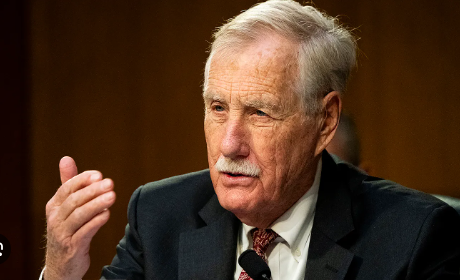
Sen. Angus King (I-Maine) on Tuesday called Secretary of State Marco Rubio’s explanation that the U.S. carried out a preemptive attack on Iran because Israel struck first “breathtaking” during a Senate hearing with a top official from the Pentagon.
King and Sen. Jack Reed (D-R.I.), the Senate Armed Services Committee’s ranking member, pressed Under Secretary of Defense Elbridge Colby about Iran as he testified on the U.S. national defense strategy. King referred to Rubio’s briefing with members of Congress on Monday where he said Israel’s strike plan pushed the U.S. to take preemptive action against an “imminent threat.“
The senator, who caucuses with Democrats, read Rubio’s remarks in which the secretary of State said “We knew there was going to be an Israeli action. We knew that that would precipitate an attack against American forces, and we knew that if we didn’t preemptively go after them before they launched these attacks, we would suffer higher casualties.”
“Have we now delegated the most solemn decision that can be made in our society, the decision to go to war, to another country?” King asked Colby. “That’s the implication, the breathtaking implication of Secretary Rubio’s statement.”
King later added that Rubio “inadvertently told the truth” that Israeli Prime Minister Benjamin Netanyahu pushed for war with Iran. The Maine senator said he supports Israel but added that no one should drive the U.S.’s decision to go to war.
Colby pushed back and said President Trump made the decision.
“Well, he made the decision, but it appeared to be based upon the fact that Israel was going to strike,” King replied.
Reed pressed Colby on the administration’s national defense strategy and the posture that the U.S. will “empower regional allies and partners to take primary responsibility for deferring and defending against Iran and its proxies.”
“This national security strategy was published, by my count, about 39 days ago,” Reed said. “So, Secretary Colby, the military operations unfolding in the Middle East are completely contrary to the strategy the department has put forth. Why has the department abandoned the strategy after 39 days?”
Colby pushed back, saying Israel and the Gulf allies “are really leaning in” by helping with military operations in Iran.
“We obviously want allies and partners throughout to be able to take responsibility,” Colby said. “But, you know, we’re looking as a general — it’s not a kind of straightjacket, if you will.”
Reed accused Trump of having “moved the goalposts” as it relates to the U.S. military objective in Iran and asked that if regime change was not part of the agenda, “why was the first objective in the campaign, the attack and death of [Ayatollah Ali] Khamenei and key leaders of the regime?”
“He sets our agenda and he directed these military goals,” Colby replied.
Trump, during a meeting with German Chancellor Friedrich Merz in the Oval Office on Tuesday, told reporters that Israel did not force the U.S. into launching strikes against Iran.
“No, I might have forced their hand,” the president said. “You see, we were having negotiations with these lunatics and it was my opinion that they were going to attack first,” he said of Iran. “They were going to attack if we didn’t do it. They were going to attack first, I felt strongly about that.”
