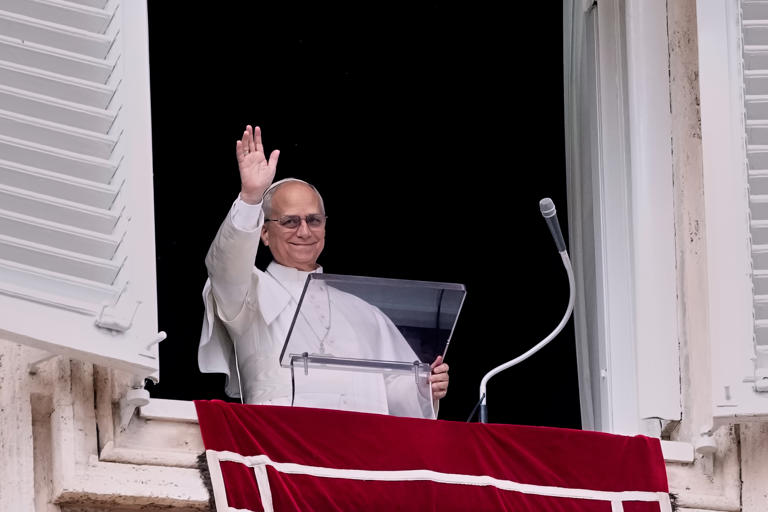
The Vatican said Sunday that Chicago-born Pope Leo XIV is not expected to visit the United States this year, dashing hopes of a triumphant homecoming tour by the new pontiff in 2026.
“No trip to the U.S. is expected in 2026,” Vatican spokesman Matteo Bruni said.
For weeks, senior Vatican officials have privately mused that Leo could make a papal trip to the U.S. built around the U.N. General Assembly in September and tack on legs to other American cities, including his hometown.
But, experts said Sunday, Leo is making strategic decisions about how to manage his role as the first American pope, including not wanting to be seen as overemphasizing one of the wealthiest, most powerful parts of the global church.
“He sees himself as someone who belongs to the world,” said Cardinal Blase Cupich, archbishop of Chicago. “I doubted he would come in his first year. He wants to make sure people understand he serves the whole world.”
Lino Rulli, host of SiriusXM’s popular show “The Catholic Guy,” said this is one of many careful choices Leo is making during this historic papacy.
“I think what drives a lot of this — when he speaks English, when he doesn’t, when he talks baseball, or doesn’t talk about U.S. politics — is very deliberate. I don’t think this is an off-the-cuff papacy. It’s all very calculated,” Rulli said. And Leo “doesn’t want the world to think his first priority is America.”
In December, Leo appeared to shut down the possibility of a U.S. trip on the return flight after his inaugural overseas visit to the Middle East. He told journalists that his next trips were likely to be to Africa, where Catholicism is growing the fastest, and Latin America, including Peru, where Leo previously served as a bishop and missionary and where he obtained dual citizenship.
Senior Vatican officials acknowledged that the Vatican in the past has sought to sidestep papal trips to countries during important election years, and they suggested that the November midterm elections in the U.S. could be a factor in the decision not to return home.
Leo has taken the Trump administration to task for its treatment of migrants and has offered measured critiques of U.S. military intervention in Venezuela. But especially in recent weeks, he has also sought to avoid incendiary words or direct confrontation, and he has been less strident in criticizing the administration than Pope Francis, the Argentine-born pontiff he replaced.
Cupich said he expects Leo to generally follow Vatican norms in dealings with the U.S.
“He will be in line with the approach the Holy See has taken with regard to speaking on international issues in the past,” Cupich said. “He doesn’t see himself as overly hesitant to speak on issues of the U.S. because he has this much broader view of what the needs are of the world. He won’t hesitate, but he also isn’t going to target” the U.S.
In December, Leo said he especially hoped to visit Algeria, to follow in the footsteps of Saint Augustine, the patron of his religious order. Catholic officials in Angola and Spain have said they expect the pope to visit there.
In Spain, in addition to visiting major cities, Leo is expected to make a symbolic stop in the Canary Islands, a key transit point for migrants arriving into Europe from sub-Sahara Africa, Madrid’s Cardinal José Cobo Cano told reporters last month.
The strategic rationales for not putting the U.S. on the pope’s travel schedule don’t diminish the disappointment probably felt by U.S. Catholics.
“It’s natural to be like: ‘That’s a big disappointment! He’s the first American pope, we want him to come here!’” Rulli said. “A lot of people don’t care about the nuance of it, they’re just like: ‘I want him to come because he’s the first American pope and we want to see him on “The Tonight Show.”’ We’re hungry for this. This is such a unique papacy. It would be such a shot in the arm for the U.S. church.”
