It’s the end of the world as we know it.
Far from feeling fine, however, America’s allies are increasingly reckoning with the idea that President Donald Trump’s actions mean the old global order isn’t coming back.
Trump arrived at the World Economic Forum in Davos, Switzerland, on Wednesday having completed his first year in office in his second term that has been dizzying for America’s friends and adversaries alike. But the past few days have jolted Washington’s allies, now urging each other to adjust to a new reality in light of his aggressive campaign to take control of Greenland.
The president used his own speech to row back suggestions that he might use military force against NATO allies to take Greenland, which he repeatedly referred to as “Iceland” — a different country — during the address.
“I won’t use force,” he told the crowd of world leaders and bankers at Davos.
But Trump’s hostile words, and the threat of tariffs against his allies, have convinced leaders that the old world is gone.
“The shift in the international order is not only seismic — but it is permanent, and the sheer speed of change far outstrips anything we have seen in decades,” European Commission President Ursula von der Leyen said hours before Trump was due to address world leaders.
“We now live in a world defined by raw power — whether economic or military, technological or geopolitical,” she told lawmakers Wednesday in Strasbourg, France. “And while many of us may not like it, we must deal with the world as it is now.”
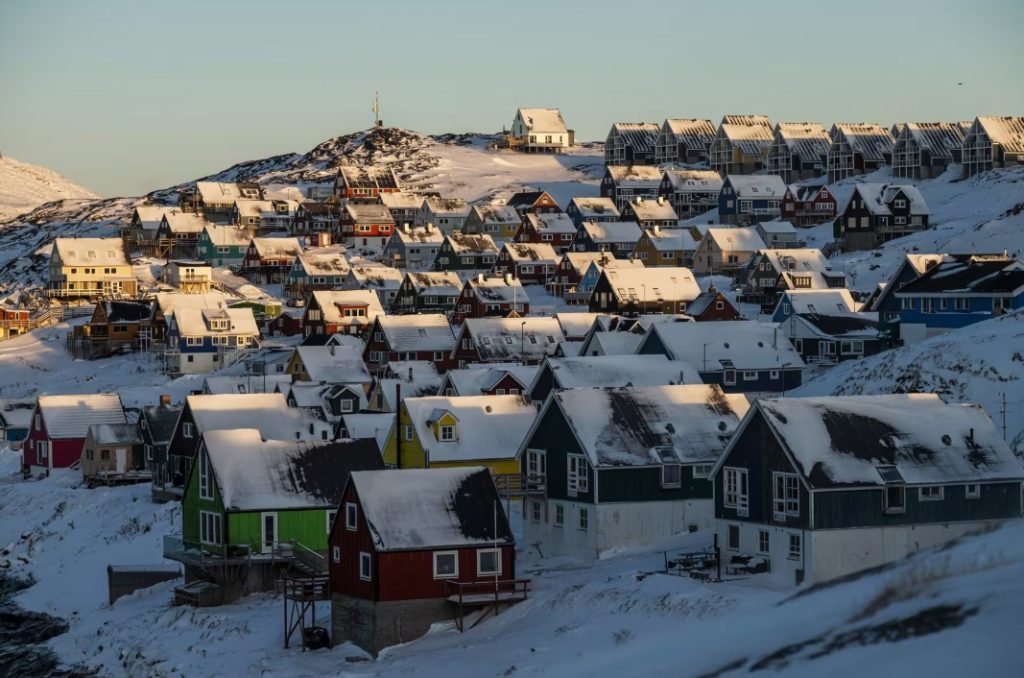
The unlikely epicenter of this geopolitical rupture is Greenland, the semi-autonomous Danish island that Trump is pursuing so aggressively he has threatened tariffs and even military action against his own NATO allies.
If the postwar “rules-based international order” was already fracturing, many now see this U.S.-led world rapidly unraveling with every leaked text exchange and artificial intelligence-generated territorial claim.
It’s not just the Europeans.
In a speech likely to go down as a historic address, Canadian Prime Minister Mark Carney gave perhaps the starkest articulation yet of what he called “a rupture, not a transition” in the geopolitical landscape.
“We know the old order is not coming back. We shouldn’t mourn it. Nostalgia is not a strategy,” he bluntly told an audience in Davos on Tuesday. “Great powers,” he said, “have begun using economic integration as weapons, tariffs as leverage, financial infrastructure as coercion, supply chains as vulnerabilities to be exploited.”
Carney also used his speech to say what many see as the quiet part out loud: That the ideas behind this Western-dominated world were often a “useful” fiction. The U.S. and its allies have often applied a selective version of these rules, exempting themselves “when convenient,” he said.
Sifting through the rubble of World War II, Western powers established multilateral institutions such as the United Nations, the International Monetary Fund and the North Atlantic Treaty Organization. Generally, American governments accepted that investment into these projects would pay dividends in global influence, protecting American interests abroad.
The result, for the U.S. and Europe, is what remains the world’s most tightly enmeshed military, economic and cultural bond. They have the world’s largest bilateral trading relationship, worth around $1,966 trillion. This means more than $5 billion of goods and services effectively cross the Atlantic Ocean every day, comprising 30% of the world’s trade.
While Europe relies heavily on U.S. might, with American troops, equipment and nuclear missiles stationed at bases across the continent, it’s also true that European components are vital in American military gear, such as the Norwegian-made missiles and British ejector seat aboard the F-35 fighter jet.
For some European officials and experts, Trump’s conduct has irrevocably changed the dynamic of this bond.
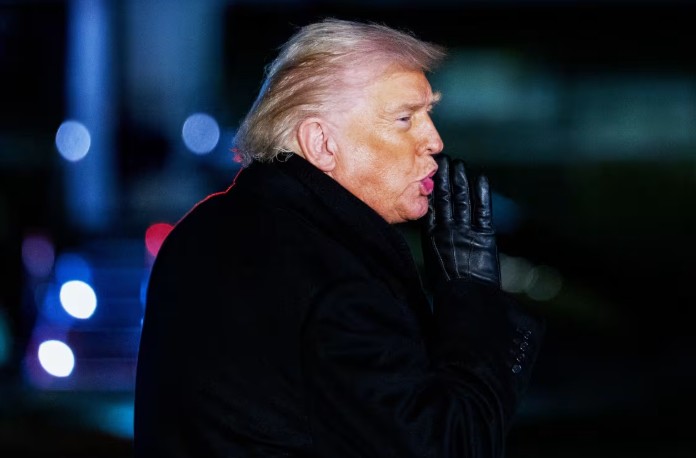
—— Trump marked a year in office Tuesday showing no sign of backing down over Greenland.
Some have attempted to use deference and even flattery to counter Trump’s hostile policy and rhetorical overtures. There seems to be a growing acceptance that has not worked.
If the U.S. used military force to oust Denmark from Greenland, NATO would effectively be finished as a concept. The president says he needs control of the island for national security, to prevent Russia and China from seizing it — though his claims have been rejected by European officials and many analysts.
White House spokesman Davis Ingle said: “President Trump was overwhelmingly elected by nearly 80 million people to deliver on his commonsense America First agenda, not to preserve the status quo of allowing other nations to rip off the United States.
“At the same time, the President has made the entire world safer and more stable by ending eight wars, securing a five percent defense spending pledge from NATO allies, obliterating Iran’s nuclear facilities, and more.”
Later Wednesday, Trump criticized Carney’s speech during his own address at Davos.
“Canada lives because of the United States — remember that, Mark, the next time you make your statements,” Trump told the audience. “I watched your prime minister yesterday. He wasn’t grateful.”
Trump has previously refused to rule out using force to take Greenland, but at a Davos said, “I won’t do that.” He wanted to seize the territory “just as we have acquired many other territories throughout our history, as many of the European nations have,” Trump said.
But Trump’s threat of tariffs has already shaken Europe.
“Until now we tried to appease the new president,” Belgian Prime Minister Bart De Wever said during a panel discussion at Davos. “But now so many red lines have been crossed that you have to choose your self-respect. Being a happy vassal is one thing. Being an unhappy slave is something else entirely.”
Europe has for years talked a good game in unshackling itself from American military dependence at least, but it remains to be seen what it does now.
Canada, meanwhile, is forging a “new strategic partnership” with China — leading many analysts to observe that Trump’s policies may be pushing allies into Beijing’s embrace.
Carney told so-called “middle powers,” such as his, to “stop invoking the ‘rules-based international order’ as though it still functions as advertised.”
But, he said: “We believe that from the fracture, we can build something better, stronger, more just.”
