The Trump administration on Tuesday imposed visa bans on a former European Union commissioner and anti-disinformation campaigners it says were involved in censoring U.S. social media platforms, in the latest move in a campaign aimed at European rules that U.S. officials say go beyond legitimate regulation.
Trump officials have ordered U.S. diplomats to build opposition to the European Union’s landmark Digital Services Act (DSA), which is intended to combat hateful speech, misinformation and disinformation, but which Washington says stifles free speech and imposes costs on U.S. tech companies.
“For far too long, ideologues in Europe have led organized efforts to coerce American platforms to punish American viewpoints they oppose,” he said on X.
“The Trump Administration will no longer tolerate these egregious acts of extraterritorial censorship,” he added.
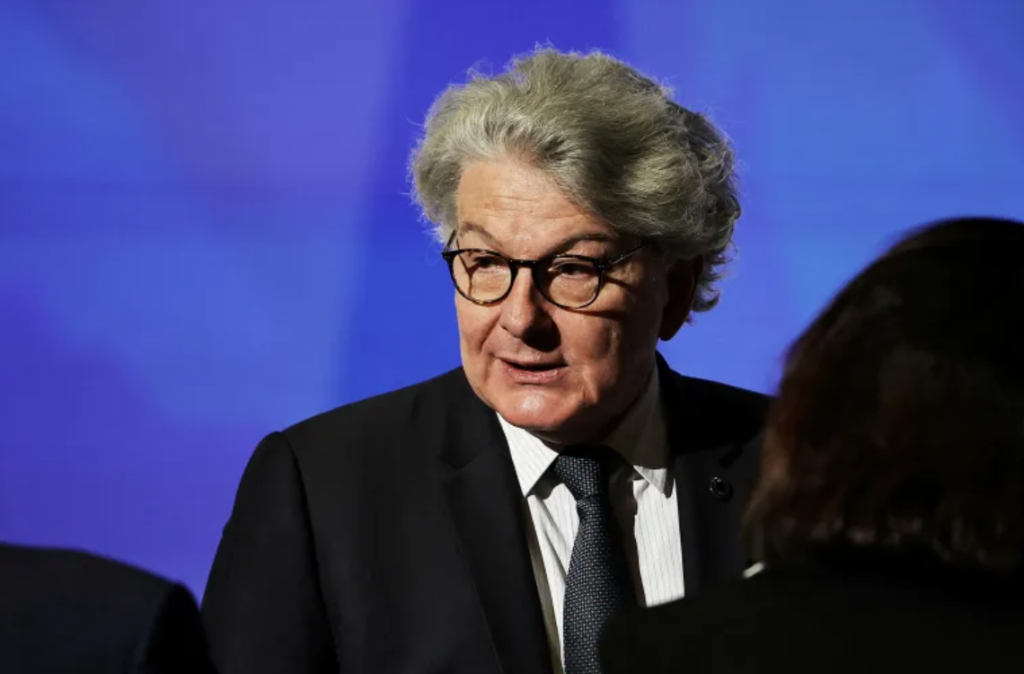
The most prominent target was Thierry Breton, who served as the European commissioner for the internal market from 2019-2024.
Sarah Rogers, the undersecretary for public diplomacy, described the French businessman as the “mastermind” of the EU’s Digital Services Act (DSA), a landmark law intended to combat hateful speech, misinformation and disinformation on online platforms.
Rogers also accused Breton of using the DSA to threaten Elon Musk, the owner of X and a close ally of US President Donald Trump, ahead of an interview Musk conducted with Trump during last year’s presidential campaign.
The others named by Rogers are: Imran Ahmed, chief executive of the Centre for Countering Digital Hate; Josephine Ballon and Anna-Lena von Hodenberg, leaders of HateAid, a German organisation, and Clare Melford, who runs the Global Disinformation Index (GDI).
French Minister for Europe and Foreign Affairs Jean-Noel Barrot “strongly” condemned the visa restrictions, stating that the EU “cannot let the rules governing their digital space be imposed by others upon them”. He stressed that the DSA was “democratically adopted in Europe” and that “it has absolutely no extraterritorial reach and in no way affects the United States”.
Ballon and von Holdenberg of HateAid described the visa bans as an attempt to obstruct the enforcement of European law on US corporations operating in Europe.
“We will not be intimidated by a government that uses accusations of censorship to silence those who stand up for human rights and freedom of expression,” they said in a statement.
A spokesperson for the GDI also called the US action “immoral, unlawful, and un-American”, as well as “an authoritarian attack on free speech and an egregious act of government censorship”.
The punitive measures follow the Trump administration’s publishing of a National Security Strategy, which accused European leaders of censoring free speech and suppressing opposition to immigration policies that it said risk “civilisational erasure” for the continent.
The DSA in particular has emerged as a flashpoint in US-EU relations, with US conservatives decrying it as a weapon of censorship against right-wing thought in Europe and beyond, an accusation Brussels denies.
The legislation requires major platforms to explain content-moderation decisions, provide transparency for users and grant researchers access to study issues such as children’s exposure to dangerous content.
Tensions escalated further this month after the EU fined Musk’s X for violating DSA rules on transparency in advertising and its methods for ensuring users were verified and actual people.
Washington last week signalled that key European businesses – including Accenture, DHL, Mistral, Siemens and Spotify – could be targeted in response.
The US has also attacked the United Kingdom’s Online Safety Act, which imposes similar content moderation requirements on major social media platforms.
The White House last week suspended the implementation of a tech cooperation deal with the UK, saying it was in opposition to the UK’s tech rules.
