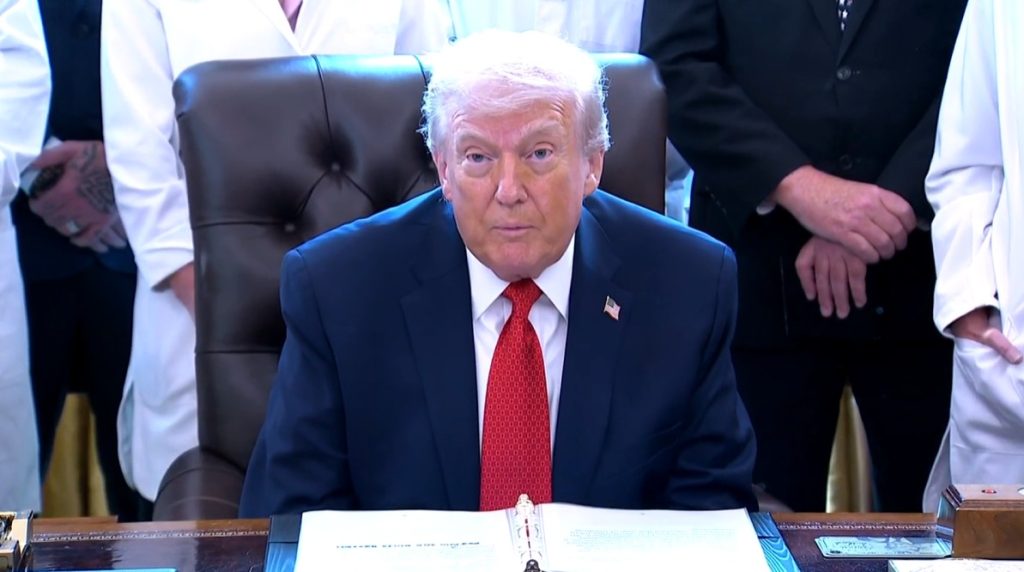
President Donald Trump signed an executive order Thursday to fast-track the reclassification of cannabis, which would pave the way for the Food and Drug Administration to study its medicinal uses.
“It is the policy of my Administration to increase medical marijuana and CBD research to better inform patients and doctors. It is critical to close the gap between current medical marijuana and CBD use and medical knowledge of risks and benefits,” the order says.
Trump said before he signed the directive in the Oval Office that it is “really something having to do with common sense.”
The order does not make cannabis legal nationwide, he said.
“It doesn’t legalize marijuana in any way, shape or form or and in no way sanctions its use as a recreational drug,” he said, adding that the order is aimed at helping people struggling with chronic pain.
Trump also indicated he would not be open to legalizing cannabis for recreational use. “It’s never safe to use powerful controlled substances in a recreational manner,” he said. “So unless a drug is recommended by a doctor for medical reasons, just don’t do it,” he said.
Cannabis is currently classified in the same category as heroin, ecstasy and LSD under the Controlled Substances Act of 1970. Trump’s order directs it to be reclassified a Schedule III substance, defined by the Drug Enforcement Administration as a drug “with a moderate to low potential for physical and psychological dependence.”
Other examples of Schedule III drugs are Tylenol with codeine, ketamine and testosterone.
The executive order directs Attorney General Pam Bondi to conclude the formal rescheduling process, which has been going on for more than a year, and move to publish a final rule that would reclassify cannabis.
Changing the classification to Schedule III would ease regulatory hurdles and allow the FDA to study medical applications for cannabis, potentially opening it up for wider medical use by seniors, veterans and others as a pharmaceutical, irrespective of state laws.
The goal of the order, a senior administration official said ahead of the signing, is to “remove barriers to research” and to “start working to improve the medical marijuana and CBD research to better inform patients and doctors. That’s the primary goal.”
The order also specifically addresses CBD — cannabidiol — which is derived from hemp plants and does not cause a high by itself. It directs the White House deputy chief of staff for legislative, political and public affairs to work with Congress to allow people in the U.S. to benefit from access to CBD products while still restricting sale and access to products that pose serious health risks, the administration official said.
Senate Minority Leader Chuck Schumer, D-N.Y., a staunch Trump critic, called the move “a step in the right direction” on X but added that “more work must be done to decriminalize cannabis, ease overly restrictive banking regulations that stall industry progress in states where it is legal, and rectify the harms done by the War on Drugs.”
According to a November Gallup Poll, 64% of U.S. adults think the use of marijuana should be legal.
