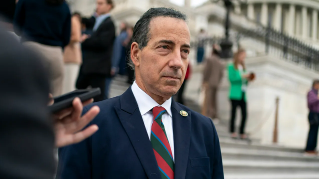
The top Democrat on the House Judiciary Committee slammed a Senate-approved plan to reopen the government that would also pave the way for eight GOP senators to earn significant sums from litigation challenging the search of their phone records related to Jan. 6.
Tucked into the GOP proposal, which eight Democratic senators also approved, the bill requires telecommunications companies to alert senators if their data has been obtained. But it also allows those whose phone records were seized as part of special counsel Jack Smith’s investigation to earn substantial sums from legal challenges stemming from the matter.
Rep. Jamie Raskin (D-Md.) called the provision “one of the most blatantly corrupt provisions for political self-dealing and the plunder of public resources ever proposed in Congress.”
The provision, which is retroactive to 2022, only applies to members of the Senate and would allow them to sue for $500,000 if data was sought without their being notified, as well as once it was obtained.
“That’s a cool one million per Senator,” Raskin said in a statement.
“There was no ‘phone tap’ or eavesdropping on the content of their conversations. The call records subpoenaed were the kind of information you see on a phone bill—a list of calls made and received,” he said, adding that the eight senators were “pathetically casting themselves as victims.”
Smith sought the phone records of eight senators as well as one member of the House during his investigation into Jan. 6, including those known to have spoken to President Trump during the riot at the Capitol.
Information recently released by Senate Judiciary Chair Chuck Grassley (R-Iowa) shows Smith subpoenaed the phone records of eight of his GOP colleagues: Sens. Marsha Blackburn (Tenn.), Lindsey Graham (S.C.), Bill Hagerty (Tenn.), Josh Hawley (Mo.), Ron Johnson (Wis.), Cynthia Lummis (Wyo.), Dan Sullivan (Alaska) and Tommy Tuberville (Ala.).
Smith also sought the records of Rep. Mike Kelly (R-Pa.), but as a House member, he would not benefit from the bill.
Raskin said it would be inappropriate for lawmakers to earn a payday from routine law enforcement action.
“The Senators may not like being treated like the rest of America, but these phone-record subpoenas and non-disclosure orders are routine in grand jury investigations at the state and federal level. No one has an absolute right to be notified that their call records have been subpoenaed, much less the right to a million bucks if it happens. This provision would not give any Americans other than U. S. Senators these rights,” Raskin wrote.
“If we believe that citizens should receive notice when the government subpoenas their phone bill, great! Perhaps this revolutionary new policy—which civil liberties groups would probably support—should be the law. But then the law should protect the civil liberties of all 320 million Americans, as the Equal Protection Clause of the Constitution demands, not just the 100 Americans in the Senate.”
The legislation does include some caveats. The Justice Department would not be required to alert a senator that their records were sought if the lawmaker was the target of the investigation, allowing a federal judge to delay any such notification requirements.
The legislation comes as Trump has also sought compensation from the Justice Department related to his own legal troubles, asking for a $230 million settlement related to the investigation conducted by special counsel Robert Mueller and from Smith’s classified documents probe.
