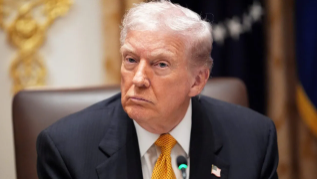
President Trump has hit his lowest approval rating since taking office for his second term in the White House, according to a Decision Desk HQ (DDHQ) polling average.
Trump’s approval rating stands at an average of nearly 42 percent, with an average disapproval rating of close to 55 percent, according to DDHQ.
“If you have a major event like basically [the] longest shutdown in history, and it also happens to be the time when Trump’s approval rating drops and then kind of stays down to a degree we haven’t quite seen in his time in office, at least the second time around, I think you have to say the shutdown’s at least part of the story,” said Geoffrey Skelley, chief elections analyst at DDHQ.
The government shutdown has dragged on for a record 43 days, though Congress looks poised to end the stalemate. Senate Democrats helped Republicans advance a government funding bill over the weekend that lasts through the end of January, with Republicans agreeing to allow for a separate vote over health care subsidies. The House is expected to vote on the bill on Wednesday.
Trump has largely been in the mid-40s for most of his presidency so far. Skelley noted that it’s difficult for any president to remain over 50 percent in their approval ratings and that Trump is grappling with frustration over the country’s current track, as well as the economy.
Skelley said he anticipates Trump will see a small rebound again once the shutdown is over.
“If his floor is around 40 percent or maybe even the high 30s, can it actually dip below that, or will it just bounce back up into the mid-40s now that the government shutdown is over?” Skelley said.
He also noted that Trump’s approval rating is higher than it was at a similar point during his first term in office. Polling from Gallup, for example, showed the president’s approval rating in November 2017 was between 35 percent and 28 percent, while a survey from The Washington Post and ABC News released that same month showed Trump at 37 percent approval.
“Republicans were somewhat more likely to say they disapproved of Trump. Trump was still sort of rallying elements of the party to him and you could argue new elements that may not have identified as Republican yet in the aftermath of the 2016 election,” Skelley said of the 2017 polling dynamics.
Skelley said that if Trump’s approval rating refused to change by next year’s elections, that would forebode bad signs for the GOP, making it all the more urgent that Republicans clinch key redistricting wins by 2025.
“If Trump’s approval rating’s at like 42 percent, like it is right now, in November of 2026, I mean, that’s not good for the GOP. They will probably lose some seats that we wouldn’t expect them to lose right now,” he said.
