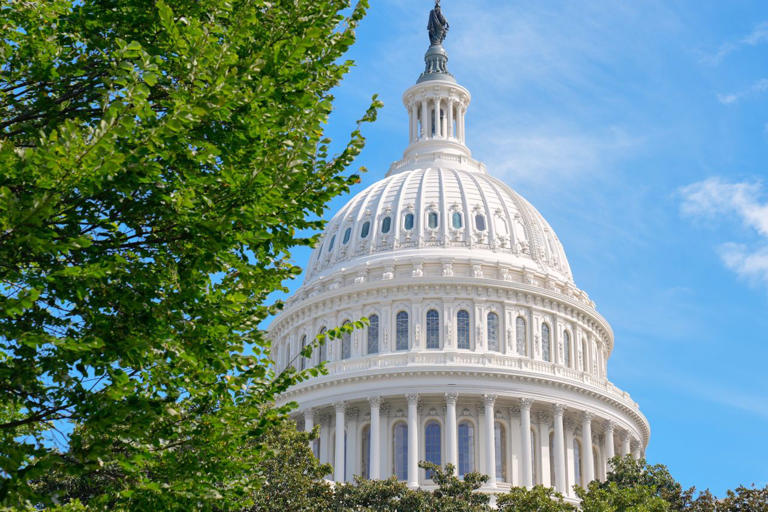
WASHINGTON—President Trump has agreed to meet in the Oval Office with the four top congressional leaders, setting up dramatic last-minute talks just as Republicans and Democrats are bracing for a government shutdown within days.
The meeting is scheduled for Monday, according to people familiar with the matter, ahead of an expected redo of a Senate vote that will determine whether Congress will keep the government funded beyond Tuesday. House Republicans narrowly passed a bill this month that would fund the government into late November and add millions for security for lawmakers and other officials, but Democrats blocked that measure in the Senate and sought bipartisan negotiations on healthcare funding.
The meeting will include House Speaker Mike Johnson (R., La.) and Senate Majority Leader John Thune (R., S.D.) along with their Democratic counterparts, Senate Minority Leader Chuck Schumer (D., N.Y.) and House Minority Leader Hakeem Jeffries (D., N.Y.).
“President Trump has once again agreed to a meeting in the Oval Office,” Schumer and Jeffries said in a statement, a reference to a canceled sit-down last week. “As we have repeatedly said, Democrats will meet anywhere, at any time and with anyone to negotiate,” they said.
The government will shut down Wednesday at 12:01 a.m. if Congress can’t pass a short-term spending patch. The Senate was set to vote again as soon as Monday on the same seven-week funding extension that Democrats had previously rejected. Republicans have a 53-47 majority, but they need 60 votes to pass most legislation.
Democrats have demanded Republicans make concessions, with a particular focus on extending enhanced Affordable Care Act subsidies that expire this year. Around 20 million Americans could see higher insurance bills unless Congress acts, and both Schumer and Thune have said that a resolution to the standoff would likely involve some sort of negotiation over the ACA credits. Democrats also want to restore Medicaid funding that was cut, and unfreeze federal spending approved by Congress but withheld by Trump administration officials.
Republicans have said Democrats should agree to a stopgap bill now and leave any negotiations for later this fall. Trump has cast Democrats as “crazy” and said blame for a shutdown would fall on them.
If the government “has to shut down, it’ll have to shut down, but they’re the ones that are shutting down,” Trump said on Friday.
Trump previously said he was willing to sit down with Democratic leaders to discuss a deal, but by Tuesday, he called it off, saying their demands were unreasonable. Schumer called Thune on Friday and urged him to get Trump to meet, a Schumer aide said.
Both sides are bracing for at least a short shutdown. Johnson canceled votes that were previously scheduled for this coming Monday and Tuesday—a move that put pressure on Senate Democrats to accept the Republican-written extension before them as there is no way to pass an alternative bill by Oct. 1.
A shutdown would force the furlough of hundreds of thousands of federal workers and restrict a range of government operations. Critical services would continue, and Americans would continue to get Social Security payments and mail deliveries. In a move to raise the stakes for Democrats, the White House on Wednesday evening instructed agencies to also draw up lists of federal workers to fire if there is a shutdown.
Democrats brushed off that threat, saying that Trump officials have already laid off large swaths of the federal workforce since January.
On a private call with House Democrats on Friday, Jeffries reiterated his confidence in Schumer and his colleagues to hold firm.
Senate Democrats “have a lot of leverage right now, and I’ve heard from people who will be hurt the most by a shutdown that they want Senate Democrats to use their leverage,” said Rep. Suhas Subramanyam (D., Va.), whose suburban district is home to a large number of federal contractors.
Schumer faced fury in March after nearly a dozen Senate Democrats voted with Republicans to avoid a shutdown, saying it was the best of bad options. But the political environment has made it easier for Schumer and Senate Democrats to reject another Republican-written partisan deal this time, according to House lawmakers and aides.
