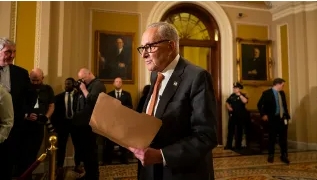
Cracks are starting to form in the Senate Democratic caucus over whether to hold the line against a seven-week clean government funding stopgap passed by the House, according to Democratic sources who say a threat by President Trump to lay off thousands of federal workers is changing the Democratic political calculus on a shutdown.
Senate Democratic Leader Chuck Schumer (N.Y.), who faces a potential primary challenge from Rep. Alexandria Ocasio-Cortez (D-N.Y.) in 2028, has made it clear he won’t vote for the House-passed GOP stopgap, but centrists in his caucus are looking for a way to avoid a catastrophic shutdown.
Sen. Jeanne Shaheen (D-N.H.), who plans to retire from the Senate at the end of 2026, has been “putting out feelers” to Republican senators about reaching some sort of deal or mutual understanding to avoid a government shutdown next week, according to a source familiar with her conversations with Senate colleagues.
Shaheen told Semafor in an interview Wednesday that she sees “a number of ways” to avoid a government shutdown “that should satisfy both sides” and opened the door to voting for the House-passed stopgap next week when Senate Majority Leader John Thune (R-S.D.) brings it back to the Senate floor.
“I’m not going to draw a line in the sand and say it’s got to be this way or that way,” she said.
Democratic sources familiar with internal caucus discussions say there are a handful of Democratic senators who want to avoid a government shutdown, even though they have little room to maneuver given the hard line drawn by Schumer and House Democratic Leader Hakeem Jeffries (N.Y.) against the House-passed continuing resolution.
Senate Democratic sources say Trump’s threat to use the shutdown as a justification to order agencies to fire federal employees working for programs that are “not consistent with the president’s priorities” raises tough questions about whether it’s worth triggering a shutdown to put pressure on Republican leaders to make concessions on health care spending.
Schumer on Wednesday dismissed a memo from the White House budget office directing agencies to use a shutdown as “an opportunity to consider reduction in force (RIF) notices” as something that would be overturned by the courts.
“This is nothing new and has nothing to do with funding the government. Their unnecessary firings will either be overturned in court or the administration will end up hiring the workers back, just like they did as recently as today,” Schumer said in a statement late Wednesday.
But Democrats who are wavering over Schumer’s pleas to hold the line against the Republican funding bill are worried about how the Supreme Court, which has a 6-3 conservative majority and a recent history of handing down rulings in Trump’s favor, will ultimately come down on the issue.
Only a small number of the hundreds of lawsuits filed against the Trump administration have reached the Supreme Court, which on Monday cleared the way for Trump to fire Rebecca Slaughter, a commissioner on the Federal Trade Commission. The court signaled it would reconsider a nearly century-old precedent limiting executive power over independent agencies.
A Senate GOP aide confirmed bipartisan talks are underway outside the Democratic leadership to find a way to pass a clean, short-term funding bill before Tuesday night.
“There is a small handful of intelligent Democrats who don’t want to see the government shut down [and] are working behind the scenes,” the source said.
“I know Democrats have spoken with Republicans,” the aide added, emphasizing GOP leadership is not prepared to give away any significant concessions at this point.
At least eight centrist or retiring Democratic senators need to break with Schumer to pass the funding stopgap. That’s a tall order, given Schumer’s firm grip on the caucus since taking over as leader in 2017.
Republicans control 53 seats, but Sen. Rand Paul (R-Ky.), an outspoken fiscal conservative, says he will oppose the GOP funding measure because he says it prolongs Biden-era spending levels.
Sen. Lisa Murkowski (R-Alaska) voted against the House GOP-drafted stopgap funding bill last week and has expressed concern about the expiration of enhanced health insurance premium subsidies at the end of this year, something the House bill failed to address.
Murkowski, however, would likely vote for a clean continuing resolution if it has more bipartisan support and a good chance of passing the Senate.
Schumer and Sen. Brian Schatz (Hawaii), the Democrats’ chief deputy whip, have said definitively that they will not vote for the clean House GOP-drafted stopgap funding the government through Nov. 21.
Eight other Senate Democrats who voted for the six-month House GOP continuing resolution in March are still in play.
They include Sen. John Fetterman (Pa.), who was the only Senate Democrat to vote last week for the House-passed continuing resolution. That measure failed on the Senate floor by a 44-48 vote.
Other potential yes votes include retiring Democrats who voted for the March stopgap, such as Senate Democratic Whip Dick Durbin (Ill.) and Sen. Gary Peters (Mich.).
Durbin voted against the House-passed continuing resolution last week and urged Trump to negotiate with Schumer and Jeffries, but he didn’t rule out voting for a funding measure before the deadline.
Sen. Catherine Cortez Masto (D-Nev.) hasn’t yet said how she would vote if the GOP funding measure comes back to the floor Tuesday.
Shaheen’s home-state colleague, Sen. Maggie Hassan (D-N.H.), and Sens. Kirsten Gillibrand (D-N.Y.) and Angus King (I-Maine) — who all voted for the March stopgap — are also in the mix.
