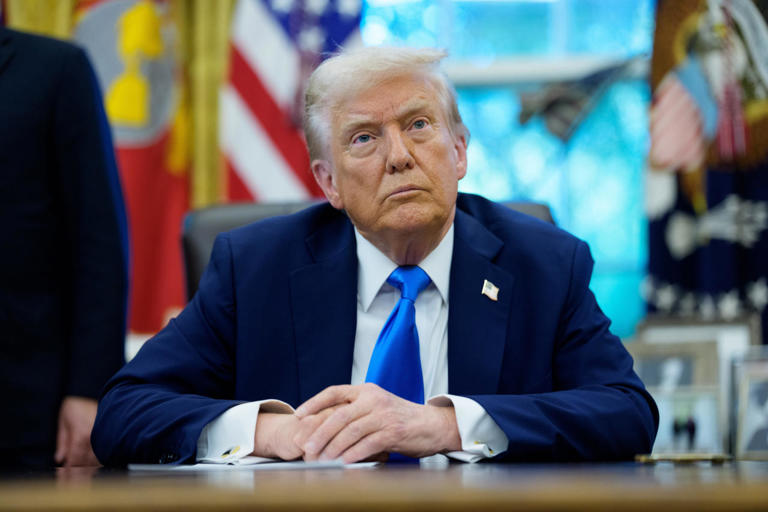
The White House raced to calm panicked tech executives over the weekend after President Trump’s changes to the popular H-1B visa plunged the program into chaos. The announcement on Friday that the administration planned to add a new $100,000 annual fee for H-1B visa applications beginning at 12:01 a.m. ET Sunday caught companies and employees off guard, setting off a wave of anxiety and confusion. Many feared they would have to pay the fee for existing H-1B holders trying to return to the country after that time.
Amazon, Alphabet’s Google, Microsoft and others warned H-1B holders not to leave the U.S. and urged employees overseas on the visa to return on Saturday because it could be difficult to re-enter, according to notes sent to staff reviewed by The Wall Street Journal and people familiar with their contents. Companies worried they could be on the hook for enormous fee payments given how many of their employees use such visas.
Human-resources staffers divided up lists of workers and tried to determine employees’ locations so they could help them book flights, if needed. Immigration lawyers, meanwhile, sent bulletins to companies and visa holders and tried to address concerns—but often found themselves with few answers.
Attempting to calm the escalating panic, the White House on Saturday said the changes only apply to new visas, not renewals, current visa holders or 2025 lottery winners. The new policy doesn’t affect the ability of existing visa holders to travel to and from the U.S., and the $100,000 is a one-time—not annual—fee, the White House added.
Some workers said they still remain uneasy about leaving the country and are uncertain what comes next. One said his H-1B status doesn’t go into effect for several weeks. The clarifying guidance from the White House provided some initial relief, but he said he still wouldn’t risk traveling to visit family in India. His mother has heart problems, and he fears needing to choose between the career he’s spent years building and being with his family should an emergency occur.
Some immigration specialists said they expect the Trump administration’s move is just the beginning of more changes likely to affect H-1B holders.
“We believe this is just step one on the government’s attack on the H-1B program,” said Shanon R. Stevenson, co-chair of the immigration practice group at law firm Fisher Phillips.
When the president announced the move on Friday in the Oval Office, he and Commerce Secretary Howard Lutnick said companies would support the change. “All of the big companies are on board,” Lutnick said.
When asked if the policy would apply to existing visa holders, Lutnick appeared to say yes. “Renewals, first time: the company needs to decide…Is the person valuable enough to have a $100,000 a year payment to the government? Or they should head home and go hire an American,” he said.
H-1B workers said winning the visa lottery feels like a landmark moment, one that often comes after years of paperwork, hefty fees and waiting periods. But some H-1B workers said the regulations as initially announced essentially amounted to a travel ban.
Saturday’s clarification from the White House capped an extraordinary 24-hour period. The proclamation “came with no notice or even a hint that something like this was coming,” said Stevenson, who spent much of Saturday fielding calls and emails from clients in fields ranging from healthcare to manufacturing. “It’s been obviously very devastating.”
Many employers were still digesting the announcement when the White House issued its clarification. By then, companies had already set new plans in motion and many workers had upended travel plans.
Tech-services firm Cognizant urged any employees on H-1B visas outside the U.S. to return before the proclamation took effect. Microsoft told employees: “If you are in H-1B status and are in the U.S., you should remain in the U.S. for the foreseeable future.”
Google and Microsoft declined to comment, while Amazon didn’t respond. A Cognizant spokeswoman said the company had reduced its dependency on visas in recent years and stepped up local hiring.
Hiba Anver, a partner at Erickson Immigration Group, a law firm based in Arlington, Va., said one client was on a cruise in international waters, while others were having difficulty finding flights to the U.S. before the White House issued its clarification.
“They’re trying to figure out if it’s better for them to get to Guam or Hawaii, just out of sheer desperation because it’s not that easy to be able to find immediate international flights back to the U.S. depending on where you are,” Anver said.
Posts across social media attested to travel chaos, with people describing being pulled from meetings and immediately sent to the airport. Some travelers were trying to connect through Abu Dhabi, where they can pass through U.S. immigration before arriving in America. Others said they were canceling trips out of the U.S.
“They’re truly in scramble mode,” said Nolan Church, the former head of talent at DoorDash and chief people officer at Carta, who said text threads flashed all night from executives at other companies. Many expected a policy change, but what appeared to be a short window to get employees back in the country presented a significant logistical challenge: “This is going to sound hyperbolic, but it’s not—they’re trying to make sure families aren’t getting separated.”
Church, now an executive recruiter, said one of his contacts assigned each HR staff member dozens of H-1B employees to track down, “viciously texting them” to determine their locations. If any are out of the country, “they are going to move heaven and earth” to return them to the U.S.
