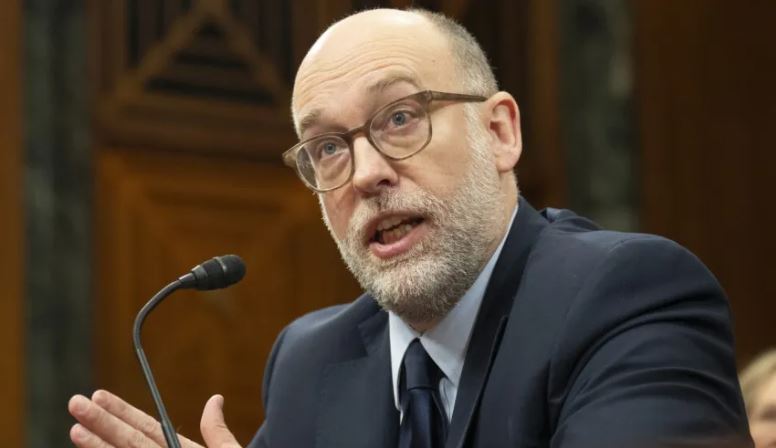
President Trump’s budget chief Russell Vought argued that the prediction the tariffs will take a major bite out of U.S. deficit levels is a key part of the administration’s argument for the GOP’s “big, beautiful bill.”
The Congressional Budget Office (CBO) found Wednesday that Trump’s tariffs will reduce the deficit by $2.5 trillion over the next decade, while also finding that the bill passed by the House would add $2.4 trillion to deficits through 2034.
Vought, who is the director of the Office of Management and Budget, said that the tariffs shrinking the size of the U.S. government should be “part of the story” for the megabill.
“The fact that it’s not carried in the bill does not mean that it’s not part of a coherent fiscal agenda. And so when we look at all of the moving parts that this administration has been a part of, it is a major part of it,” Vought told reporters.
“I think it is a very fair item for us to include in our fiscal arguments that we’re going to be telling the story about. In just five to six months, we’re essentially taking a third of the entirety of the problem head on, and if our actions are decisive and paradigm-shifting, they will accrue over many years,” he added.
Senate GOP talks cutting Medicare ‘waste, fraud’ to offset cost of Trump tax bill
Next
Stay
The tariffs measured by the CBO included those that Trump implemented from Jan. 6 to May 13, which includes the trade truce with China announced on May 12.
Meanwhile, Trump’s “big, beautiful bill” has faced pushback from fiscal hawks and former top adviser Elon Musk over its potential to add to the nation’s deficit.
Sign up for the Morning Report
The latest in politics and policy. Direct to your inbox.
Email address
By signing up, I agree to the Terms of Use, have reviewed the Privacy Policy, and to receive personalized offers and communications via email, on-site notifications, and targeted advertising using my email address from The Hill, Nexstar Media Inc., and its affiliates
The CBO estimated the proposed tax cuts in the plan, which lock in expiring provisions in Trump’s 2017 tax law, and other add-ons would decrease revenues by more than $3.6 trillion over the next decade, while accompanying measures to cut federal spending, like reforms to Medicaid and the Supplemental Nutrition Assistance Program, would reduce outlays by $1.2 trillion.
Musk has called for killing the House bill after he called the legislation passed by the House “pork-filled” and a “disgusting abomination” the day before.
Vought brushed off the criticism and suggested the White House isn’t worried about the effort to scrap the legislation that passed the House.
“I think we’re in a very good place on the bill. We’re having excellent conversations with the Senate,” he said. “I don’t think the extent to which there are opposing views on the outside are hurting our ability to pass this bill. I really don’t.”
Speaker Mike Johnson (R-La.) also told reporters Wednesday that there isn’t time for a new bill in response to Musk’s comments.
“We worked on the bill for almost 14 months. You can’t go back to the drawing board, and we shouldn’t,” Johnson said. “We have a great product to deliver here. So I know it doesn’t … it’s not perfect by some peoples’ estimations.”
